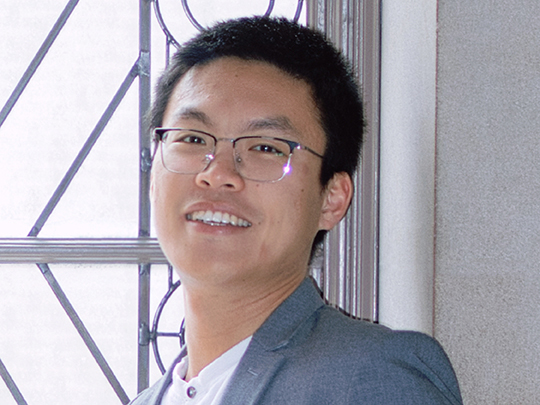
 The Department of Biochemistry welcomes Wei Wei, who joined the faculty on August 1, 2025. The Wei Lab will explore the fundamental question: How does what we eat affect our health?
Wei majored in biomedical sciences at Zheijiang University in China. As an undergraduate, Wei gained research experience in the United States as a summer researcher, first at Boston Children’s Hospital and later at the University of California, Davis.
As a graduate student at Stanford University, Wei’s research examined how metabolic processes are impacted by physiological pressures, including exercise and eating. His doctoral work included developing a tool to help scientists map the secretion and movement of metabolically important polypeptides, such as insulin. Wei’s postdoctoral research, also completed at Stanford University, took a more chemistry-focused approach, studying the roles of nutrients in regulating homeostasis in mammals.
As an assistant professor at UW–Madison, Wei will examine the biochemical nature of nutrients within our food to understand their physiological effects at the molecular level. “I want to approach my research from a basic biochemical viewpoint to better understand how chemicals in our food feed into the basic biochemical network within our bodies,” says Wei. “How do they react with enzymes? How do they get transported? And what is the impact on physiology?” His lab will combine protein biochemistry, structural biology, mass spectrometry, and animal physiology.
Wei says that, with its long history of metabolic research that continues into the present, the Department of Biochemistry is an ideal place to build his lab and establish new collaborations. “I am excited to work with new colleagues in the Department who are doing such great work in metabolism and biochemistry in general. I came here because the Department is highly supportive and truly cares about the growth of new faculty and also of the student trainees,” says Wei. “Throughout my time in the United States, I have met incredible scientists who tell me that they studied biochemistry at UW–Madison.”
Wei attributes his own success to mentors who allowed space for his interests and skills to evolve. He plans to approach each student in his lab with the support that they need, whether that means more hands-on mentorship or giving them space, allowing students to come to him when they need help. “People are all different,” notes Wei. “People need different things at different phases. My job is to help students find their confidence and give them the support they need to grow and make progress. Then, to know when I can give them more space to find their own way.”
As a person who devotes his research to understanding the impacts that diet and exercise have on our bodies, Wei prioritizes physical activity in his time outside of the lab. While Wei especially enjoys playing basketball, he says that students in his lab will be strongly encouraged to find their own passion outside of the lab. “It’s so important to have something in your life that isn’t research,” Wei reflects. “There are a lot of ups and downs in research projects, and often it can be more downs than ups. Scientists are more resilient researchers when we can walk out of a difficult day in the lab and know that there’s something beautiful waiting outside. It can be anything — cooking, music, games, or, of course, exercise.”
Written by Renata Solan.