 UW–Madison undergraduate students play an important role in research happening all over campus. Biochemistry majors jump into projects across a wide range of fields related to their major, and the mix of their research experiences, classes, and extracurriculars sets them up for a diverse range of career paths.
In this series, some of these students share how their interests have taken shape, how working in labs has changed the way they see research, what they’ve learned from classes outside their major, and how they’ve found community along the way.
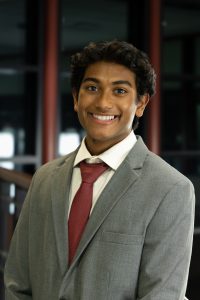
Kavinu Weerawardhene was born in Sri Lanka and grew up near Prior Lake, Minnesota. He is a senior majoring in biochemistry and conducts research in the Rui Lab in the Department of Medicine.
Did you come to UW–Madison knowing you wanted to major in biochemistry?
My dad got his masters degree in electrical engineering at UW–Madison. I grew up visiting here, getting ice cream on campus, and knew that it would be a great place to go to school. In high school, I really liked my biology and chemistry classes, so I came to college thinking combining those two subjects would be really interesting. I knew I wanted to have a career that is in some way related to healthcare, and a biochemistry major is a great way to have all of the requirements for almost any healthcare-related career. Plus, I love Spiderman and [his alter ego] Peter Parker studied biochemistry.
Tell us about your research.
I have been working in the Rui Lab since my sophomore year. I have been studying overexpression of DNA methyltransferase on mantle cell lymphoma. The research is interesting and it really feels like there’s an opportunity to have a big impact on our understanding of cancer and the field of oncology. Last year, I took a step back from my research to focus on school and exams, but I’m really looking forward to continuing my research in the Rui Lab this fall. It’s a very supportive place where I can grow and learn as a scientist and with my academics. I also worked as a student lab assistant in the Fan Metabolism Lab in the Morgridge Institute for Research and I was able to build a lot of skills in that position by doing RNA extractions and mycoplasma testing for quality control.
What classes outside of your major have you especially enjoyed?
I took Climate Crisis Literature with Professor Sarah Wood. It was such a different way of thinking and learning than my STEM classes. I’ve always heard “read between the lines” and in this class I learned how complicated that can be. We read The Overstory by Richard Powers and Flight Behavior by Barbara Kingsolver. Those books are not as black and white as a textbook, I had to analyze what the author is saying beyond the words. Best of all, that class got me back into reading for fun. The class also got me thinking about moral tradeoffs. Like, for example, the ways scientific research benefits society and the plastic waste associated with that research.
Where have you found community at UW–Madison?
I found a lot of community by being a part of study groups for some of my STEM classes. We’re all going through the same thing and we get to help each other out and just be there to support each other. Your study group becomes your friends. I also joined the Alpha Kappa Psi business fraternity, so I am surrounded by peers with diverse interests. I love being one of the only biochem majors in the group because it means that I get exposed to a bunch of different perspectives and priorities that are different from what I’m taught in my major.
What do you hope to do after you graduate?
I worked as an intern at Pfizer Oncology over the summer in Washington. I learned a lot about how experimental timelines work in an environment that’s fast pace with large scale research. As I put the data together over the time I was there, I started to really see the big picture of the research I was working on. I want to find the area of science research that truly lights me up. I’m going to take some time before I apply to graduate school so I can get a better idea of what that is.
Undergraduates majoring in biochemistry can email communications@biochem.wisc.edu to participate in the Undergrad Profile series.