
Michael M. Cox
Emeritus Professor 2024-present
Professor 1983-2023, Evelyn Mercer Professorship in Biochemical Sciences
2305C HF DeLuca Biochemical Sciences Building
440 Henry Mall, Madison, WI 53706-1535
Education
B.A., University of Delaware; Ph.D., Brandeis University
Areas of Expertise
- Biomolecular Folding & Interactions
- Chemical Biology & Enzymology
- DNA Metabolism & Genome Maintenance
Publications
Molecular biology and enzymology of genetic recombination and DNA repair
Cellular replication is rarely completed unimpeded from initiation to termination. Barriers to replisome progress abound in the form of DNA lesions, strand breaks, or bound proteins – each presenting a unique bypass challenge. A constellation of specialized enzymatic activities escort replisomes past bound proteins or transcription complexes, reconstruct broken forks after encounters with template strand breaks, reinstall active replisomes on the reconstructed forks, and transiently regress stalled forks to allow repair of downstream DNA lesions. Much of the genome instability associated with cancer can be traced to missteps at the critical interfaces between replication, repair, and recombination.
Research in the Cox lab has traditionally been focused on the repair of stalled or collapsed replication forks, primarily by the recombinational DNA repair of double strand breaks. Recent discoveries in the lab have serendipitously led us to a long-appreciated but under-explored reality: forks often do not halt at template strand lesions. Instead, DNA synthesis is aborted and reinitiated upstream, leaving the lesion behind in a postreplication gap. Repair occurs behind the fork. The generation of postreplication gaps was first detected in the 1960s. However, in the absence of the systematic attention garnered by other fork repair pathways – ensured in part by a lack of appropriate methodology – the role of postreplication gaps in genome maintenance has required periodic rediscovery. Much of our work has now been re-focused on DNA repair in postreplication gaps, and the enzymes that carry it out. The work features new enzymes and new processes. In addition, we are working on a long-term experimental evolution project to explore resistance to ionizing radiation.
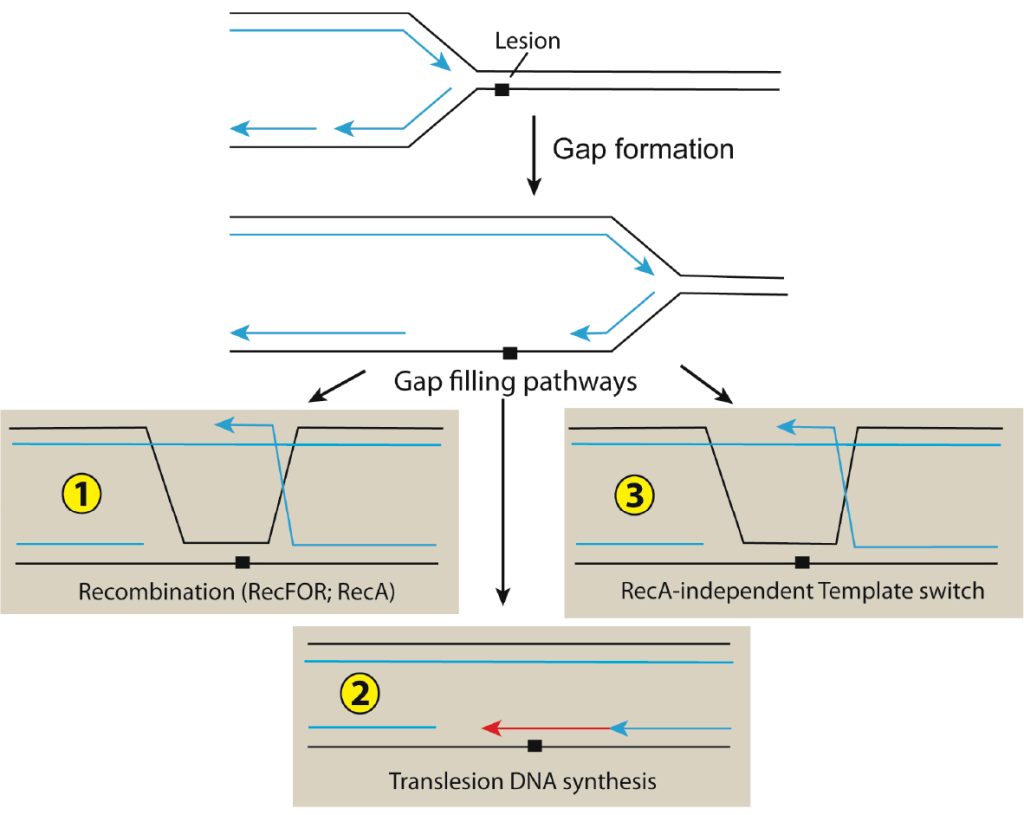
There are currently two themes to the work in this laboratory:
Theme 1. DNA repair in postreplication gaps
Most DNA repair pathways are predicated on the fact that DNA is double stranded. A lesion in one strand can be repaired by removing part of the damaged strand and filling in the gap by using the undamaged complementary strand as a template. However, when the lesion is in a single strand gap, there is no complementary strand to repair against; such a complement must be provided via gap filling before repair can proceed. In all organisms, there are three pathways for gap filling: (1) Recombinational gap repair. In bacteria, recombination in gaps proceeds by a pathway involving the RecFOR proteins and the RecA recombinase. (2) Template switching. This pathway is both prominent and enigmatic. It is readily detected via assays that monitor RecA-independent recombination. (3) Translesion DNA synthesis (TLS). E. coli has three TLS DNA polymerases, II, IV, and V.
To explore the broader metabolism of DNA gaps, we are studying the following enzymes, all of which are ATPases albeit of different classes:
The RecF protein
This ATPase has been characterized as part of the RecFOR pathway for loading RecA recombinase onto SSB-coated single strand DNA. However, RecF is not known to form any complexes with RecO. Instead, RecR makes complexes alternatively with RecF or RecO. The RecO and RecF complexes do not colocalize in the cell. RecF spends much time at the replication fork. RecO spends most of its time at sites distal from the fork. We are working to improve understanding of RecF’s true function.
The RarA protein
The rarA gene (rar=replication associated recombination) encodes a 447-amino-acid polypeptide with a predicted MW = 49594. RarA is part of a highly conserved family, sharing roughly 40% identity and 56-58% similarity with its Saccharomyces cerevisiae (Mgs1; Mgs=Maintainance of genome stability) and Homo sapiens (WRNIP1; WRNIP=Werner’s interacting protein) homologs. RarA also shares considerable sequence homology with the τ, δ and δ′ subunits of the DNA polymerase III clamp loader, placing RarA in the clamp loader AAA+ clade. However, unlike other clamp loader proteins, RarA functions as a tetramer rather than a pentamer. Each protomer consists of three structural domains – an N-terminal ATP binding domain, an adjacent helical lid domain, and a C-terminal tetramerization domain. Loss of this activity in any organism leads to a decline in genome stability. A few years ago, my student Asher Page, in collaboration with Jim Keck’s lab, solved the structure of this protein to provide the first structural information about this protein family. We are now actively engaged in determining the function of this protein, using approaches both in vivo and in vitro. Often found at the replication fork, we are very interested in determining what RarA is doing there.
The RadD protein
The radD gene (formerly yejH) encodes a polypeptide of 586 amino acid residues (including the N-terminal Met) with a predicted MW of 66,413. It has been implicated in DNA repair following radiation or chemical damage (128). The peptide sequence of the RadD protein includes all seven of the motifs associated with a superfamily 2 (SF2) helicase, with the motifs aligning well to E. coli SF2 helicases RecG and RecQ. RadD also exhibits significant homology to the human XPB(ERCC3). The protein binds to SSB (more-weakly than RarA) and exhibits a DNA-independent ATPase activity that is stimulated by interaction with SSB. RadD is likely involved in the resolution of branched DNA intermediates formed by template switching in gaps behind the replication fork, and perhaps other processes as well.
The Uup protein
The uup gene first attracted interest due to an observed increase in precise excision of transposons elicited by uup mutants. The uup gene encodes a 635 amino acid protein with a predicted MW of 72067. It is an ABC family ATPase in Class 2 (no transmembrane domain). UvrA protein also belongs in this class. The Uup protein has two Walker A/B domains connected by a linker and followed by a C-terminal domain. Uup appears to modulate the function of some other repair proteins, notably the RecG protein.
DNA polymerase V
DNA polymerase V is a specialized enzyme that can replicate DNA on damaged DNA templates. Induced during the bacterial SOS response, DNA polymerase V promotes mutagenic translesion synthesis (TLS). Activation of Pol V requires RecA protein at several steps, and a RecA monomer is a subunit of the active Pol V enzyme called pol V mut. Working with Myron Goodman at University of Southern California and Roger Woodgate at the NIH, we are slowly elucidating the unusual reaction cycle of this enzyme and the structural relationships between the various pol V mut subunits.
Theme 2. Resistance to extreme levels of ionizing radiation
Some bacteria, like Deinococcus radiodurans, display a robust capacity to survive exposure to astonishing levels of ionizing radiation (IR), sometimes a thousand times or more than doses that would be lethal to a human. To understand the factors most important in radiation resistance, we have carried out a directed evolution experiment, generating strains of E. coli that exhibit up to 10,000 fold greater survival after exposure to 3,000 Gy of IR. The experiment is ongoing, with a goal of eventually producing E. coli strains with levels of IR resistance that exceed that of Deinococcus. With this project, we are broadly exploring the molecular basis of extreme resistance to IR. Contributing mutations in genes involved in DNA repair, remediation of reactive oxygen species, central metabolism, and cell wall biosynthesis have all be implicated in the overall phenotype. The work involves extensive use of genomic, metabolomic, and proteomic approaches.
Our work is greatly enhanced by collaborations. Prominent collaborators at present include Jim Keck in the Department of Biomolecular Chemistry here at UW (structural biology and the enzymology of replication restart), Myron Goodman at the University of Southern California (translesion DNA synthesis), Roger Woodgate at NIH/NICHD (translesion DNA synthesis), Antoine van Oijen, Andrew Robinson, and Harshad Ghodke at the University of Wollongong, Wollongong, Australia (single molecule approaches to DNA metabolism), and Sue Lovett at Brandeis University (Genetics of DNA metabolism in bacteria).
Honors & Awards, Professional Service, & More
- Fellow of the American Society for Biochemistry and Molecular Biology (ASBMB) (the inaugural class) – 2021
- 5th Annual Award for Mentoring Undergraduates in Research, Scholarly and Creative Activities, University of Wisconsin College of Agricultural and Life Sciences – 2018
- Evelyn M. Mercer Professor in Biochemistry – 2013-2023
- Elected American Association for the Advancement of Science (AAAS) Fellow – 2011
- University of Wisconsin Regents’ Teaching Excellence Award – 2009
- WARF Kellett Mid-Career Faculty Research Award – 2000
- Vilas Associate Award, University of Wisconsin Graduate School – 1998
- Spitzer Teaching Award, University of Wisconsin College of Agriculture and Life Sciences – 1994
- Romnes Faculty Fellowship – 1989
- Eli Lilly Award sponsored by the American Chemical Society, Division of Biological Chemistry – 1989
- Dreyfus Teacher-Scholar Award – 1986-1991
- March of Dimes-Basil O’Connor Starter Research Grant (research award) 09/1984-09/1986
- National Institutes of Health Research Career Development Award – 07/1984-06/1989
- Shaw Fellowship (research award) awarded by the Milwaukee Foundation – 07/1983-06/1988
- Bank of America-Giannini Foundation Postdoctoral Fellowship – 09/1981-09/1982
- American Cancer Society Postdoctoral Fellowship – 09/1979-09/1981
- NIH Prokaryotic Cell and Molecular Biology Study Section (PCMB) Regular member 7/2019-6/2023
- NIH, NIGMS, MIRA Review Panel – 11/2015, 3/2019
- NIH Prokaryotic Cell and Molecular Biology Study Section (PCMB) – 6/2017, 6/2018, 3/2019
- NASA Research and Education Support Services (NRESS), TRI Radiation Resistance Panel Review Meeting – 7/2017
- NIH Prokaryotic Cell and Molecular Biology Study Section (PCMB) (ad hoc) – 2/2017
- NIH Cancer Etiology Study Section – 2015
- NIH Fellowships: Genes, Genomes and Genetics Study Section – 06/2014
- NSF Transforming Undergraduate Education in Science, Technology, Engineering and Mathematics Panel – 07/2012
- Editorial Board, Journal of Bacteriology – 01/2011-12/2013
- Subsection Editor, Encyclopedia of Molecular Life Sciences – 2011
- Visiting Professor, University of Paris Sud, Orsay, France – 03/2009
- AAAS Council Delegate, Section on Biological Sciences – 2007-2010
- Meeting Chair, FASEB Summer Research Conference – 2009
- Meeting Co-chair, FASEB Summer Research Conference – 2007
- Advisor, FASEB “Educating About Evolution” Subcommittee – 2006-Present
- Meeting Co-chair, Nucleic Acids Keystone Symposium – 2006
- Editorial Board, BioMed Central Microbiology – 2005-Present
- Vice chair, U.S. National Committee for the International Union for Biochemistry and Molecular Biology (USNC/IUBMB) – 2004-2006
- Member, U.S. National Committee for the International Union for Biochemistry and Molecular Biology – 2002-2005
- Editor-in-chief, Critical Reviews in Biochemistry and Molecular Biology – 2002-Present
- Meeting co-chair, Nucleic Acids Gordon Conference – 2002
- Organizing Committee, National Academy of Sciences Symposium on Relationships between Replication and Recombination, Irvine, CA, – 11/2001
- Assistant Editor, Journal of Biological Chemistry – 1999-2004
- Chief Advisor in Development of the Encyclopedia of Life Sciences/Online Encyclopedia, Nature Publishing Group, UK (launched 2001) – 1997-2009
- Council Member, American Society of Biochemistry and Molecular Biology – 1998-2001
- NIH Microbial Physiology and Genetics Study Section – 01/1993-06/1995
- NIH Special Review Committee Site Visit Review – 07/1992
- Assistant Editor, Journal of Biological Chemistry – 07/1991-01/1997
- NIH Microbial Genetics Study Section (Ad hoc) – 02/1988, 06/1990, 02/2002, 06/2003, 10/2005, 02/2006, 10/2007
2026
Sharma N, Cherry ME, Henry C, Wood EA, Robinson A, van Oijen A, Ghodke H, Cox MM. (2026) Spatiotemporal characterization of single-stranded DNA Intermediates after UV Irradiation: I: Post-replication gaps formed during slow growth
Ripandelli RAA, Wood EA, Robinson A, van Oijen AM, Cox MM. (2026) Spatiotemporal characterization of single-stranded DNA intermediates after UV irradiation: II. Rapid growth and effects of recA and recJ. PLoS Genet. 2026 May 14;22(5):e1012110. DOI: 10.1371/journal.pgen.1012110. eCollection 2026 May.
2024
Bonde NJ, Kozlov AG, Cox MM, Lohman TM, Keck JL. (2024) Molecular insights into the prototypical single-stranded DNA-binding protein from E. coli. Crit Rev Biochem Mol Biol. 2024 Feb-Apr;59(1-2):99-127. DOI: 10.1080/10409238.2024.2330372.
Pham P, Wood EA, Dunbar EL, Cox MM, Goodman MF (2024) Controlling Genome Topology with Sequences that Trigger Post-replication Gap Formation During Replisome Passage: The E. coli RRS Elements. Nucleic Acids Res. 2024 Jun 24;52(11):6392-6405. DOI: 10.1093/nar/gkae320.
2023
Sandler SJ, Bonde NJ, Wood EA, Cox MM, Keck JL. (2023) The intrinsically disordered linker in the single-stranded DNA-binding protein influences DNA replication restart and recombination pathways in Escherichia coli K-12. J Bacteriol. 2024 Apr 18;206(4):e0033023. DOI: 10.1128/jb.00330-23. Epub 2024 Mar 12.
Bonde NJ, Wood EA, Myers KS, Place M, Keck JL, Cox MM. (2023) Identification of recG genetic interactions in Escherichia coli by transposon sequencing. J Bacteriol. 2023 Dec 19;205(12):e0018423. DOI 10.1128/jb.00184-23. Epub 2023 Nov 29.
ME Cherry, K Dubiel, C Henry, EA Wood, SA Revitt-Mills, JL Keck, MM Cox, AM van Oijen, H Ghodke, A Robinson. (2023) Spatiotemporal Dynamics of Single-stranded DNA Intermediates in Escherichia coli. bioRxiv. 05.08.539320. DOI: 10.1101/2023.05.08.539320. Preprint
Cox MM, MF Goodman, JL Keck, A van Oijen, ST Lovett, A Robinson. (2023) Generation and Repair of Postreplication Gaps in Escherichia coli. Microbiol Mol Biol Rev. e0007822. DOI: 10.1128/mmbr.00078-22. Online ahead of print.
Osorio Garcia MA, EA Wood, JL Keck, MM Cox. (2023) Interaction with single-stranded DNA-binding protein (SSB) modulates Escherichia coli RadD DNA repair activities. J Biol Chem. 299(6):104773. DOI: 10.1016/j.jbc.2023.104773. [PDF]
Henry C, G Kaur, ME Cherry, SS Henrikus, NJ Bonde, N Sharma, HA Beyer, EA Wood, S Chitteni-Pattu, AM van Oijen, A Robinson, MM Cox. (2023) RecF protein targeting to post-replication (daughter strand) gaps II: RecF interaction with replisomes. Nucleic Acids Res. DOI: 10.1093/nar/gkad310. Online ahead of print
Henry C, N Mbele, MM Cox. (2023) RecF protein targeting to postreplication (daughter strand) gaps I: DNA binding by RecF and RecFR. Nucleic Acids Res. DOI: 10.1093/nar/gkad311 Online ahead of print
Pham P, EA Wood, MM Cox, MF Goodman. (2023) RecA and SSB genome-wide distribution in ssDNA gaps and ends in Escherichia coli. Nucleic Acids Res. DOI: 10.1093/nar/gkad263. Online ahead of print
Bonde NJ, C Henry, EA Wood, MM Cox, JL Keck. (2023) Interaction with the carboxy-terminal tip of SSB is critical for RecG function in E. coli. Nucleic Acids Res. 8;51(8):3735-3753. DOI: 10.1093/nar/gkad162. [PDF]
2022
Ojha D, MM Jaszczur, A Sikand, JP McDonald, A Robinson, AM van Oije, CH Mak, F Pinaud, MM Cox, R Woodgate, MF Goodman. (2022) Host cell RecA activates a mobile element-encoded mutagenic DNA polymerase. Nucleic Acids Res. 50(12):6854-6869. DOI: 10.1093/nar/gkac515. [PDF]
Osorio Garcia MA, KA Satyshur, MM Cox, JL Keck. (2022) X-ray crystal structure of the Escherichia coli RadD DNA repair protein bound to ADP reveals a novel zinc ribbon domain. PLoS One. 17(4):e0266031. DOI: 10.1371/journal.pone.0266031 [PDF]
Jain K, TH Stanage, EA Wood, MM Cox. (2022) The Escherichia coli serS gene promoter region overlaps with the rarA gene. PLoS One. 17(4):e0260282. DOI: 10.1371/journal.pone.0260282. [PDF]
Bonde NJ, ZJ Romero, S Chitteni-Pattu, MM Cox. (2022) RadD is a RecA-dependent accessory protein that accelerates DNA strand exchange. Nucleic Acids Res, 50(4):2201-2210. DOI: 10.1093/nar/gkac041 [PDF]
Pham P, Y Shao, MM Cox, MF Goodman. (2022) Genomic landscape of single-stranded DNA gapped intermediates in Escherichia coli. Nucleic Acids Res, 50(2):937-951. DOI: 10.1093/nar/gkab1269 [PDF]
2021
Jain K, EA Wood, MM Cox. (2021) The rarA gene as part of an expanded RecFOR recombination pathway: Negative epistasis and synthetic lethality with ruvB, recG, and recQ. PLoS Genet, 17(12):e1009972. DOI: 10.1371/journal.pgen.1009972 [PDF]
Bruckbauer ST, and MM Cox. (2021) Experimental evolution of extremophile resistance to ionizing radiation. Trends Genet., 37(9):830-845. DOI: 10.1016/j.tig.2021.04.011 [PDF]
Sikand A, M Jaszczur, LB Bloom, R Woodgate, MM Cox, MF Goodman. (2021) The SOS Error-Prone DNA Polymerase V Mutasome and β-Sliding Clamp Acting in Concert on Undamaged DNA and during Translesion Synthesis. Cells, 10(5):1083. DOI: 10.3390/cells10051083 [PDF]
Bruckbauer, ST, BB Minkoff, MR Sussman, MM Cox. (2021) Proteome Damage Inflicted by Ionizing Radiation: Advancing a Theme in the Research of Miroslav Radman. Cells, 10(4):1083. DOI: 10.3390/cells10040954 [PDF]
Henry, C, (from the lab of MM Cox) and S Henrikus. (2021) Elucidating Recombination Mediator Function Using Biophysical Tools. Biology, 10(4), 288. DOI: org/10.3390/biology10040288 [PDF]
Henry, C, L Loiseau, A Vergnes, D Vertommen, A Mérida-Floriano, S Chitteni-Pattu, EA Wood, J Casadesús, MM Cox, F Barras, B Ezraty. (2021) Redox controls RecA protein activity via reversible oxidation of its methionine residues. eLIFE, 10:e63747. DOI: 10.7554/eLife.63747 [eLIFE] [PDF]
Nelson, DL and Cox, MM (2021). Lehninger Principles of Biochemistry, Eighth Edition (W.H. Freeman Publishers), New York.
2020
Jain, K, EA Wood, ZJ Romero, MM Cox. (2020) RecA-independent recombination: Dependence on the Escherichia coli RarA protein. Mol Microbiol, 115(6):1122-1137 DOI: 10.1111/mmi.14655 [PDF]
Bruckbauer, ST, J Martin, BB Minkoff, MT Veling, I Lancaster, J Liu, JD Trimarco, B Bushnell, A Lipzen, EA Wood, MR Sussman, C Pennacchio, MM Cox. (2020) Physiology of Highly Radioresistant Escherichia coli After Experimental Evolution for 100 Cycles of Selection. Front Microbiol, 11:582590. DOI: 10.3389/fmicb.2020.582590 [PDF] Corrigendum DOI: 10.3389/fmicb.2020.617806 [PDF]
Henrikus, SS, C Henry, AE McGrath, S Jergic, JP McDonald, Y Hellmich, ST Bruckbauer, ML Ritger, ME Cherry, EA Wood, PT Pham, MF Goodman, R Woodgate, MM Cox, AM van Oijen, H Ghodke, A Robinson. (2020) Single-molecule live-cell imaging reveals RecB-dependent function of DNA polymerase IV in double strand break repair. Nucleic Acids Res, 48(15):8490-8508. DOI: 10.1093/nar/gkaa597 [PDF]
Romero, ZJ, SH Chen, T Armstrong, EA Wood, A van Oijen, A Robinson, MM Cox. (2020) Resolving toxic DNA repair intermediates in every E. coli replication cycle: critical roles for RecG, Uup and RadD. Nucleic Acids Res, 48(15):8445-8460. DOI: 10.1093/nar/gkaa579 [PDF]
Bruckbauer, ST, BB Minkoff, D Yu, VL Cryns, MM Cox, MR Sussman. (2020) Ionizing Radiation-Induced Proteomic Oxidation in Escherichia coli. Mol Cell Proteomics, 19(8):1375-1395. DOI: 10.1074/mcp.RA120.002092. [PDF]
Dubiel, K, C Henry, LM Spenkelink, AG Kozlov, EA Wood, S Jergic, NE Dixon, AM van Oijen, MM Cox, TM Lohman, SJ Sandler, JL Keck. (2020) Development of a Single-Stranded DNA-binding Protein Fluorescent Fusion Toolbox. Nucleic Acids Res, 48(11):6053-6067. DOI: 10.1093/nar/gkaa320 [PDF]
Romero, ZJ, TJ Armstrong, SS Henrikus, SH Chen, DJ Glass, AE Ferrazzoli, EA Wood, S Chitteni-Pattu, AM van Oijen, ST Lovett, A Robinson, MM Cox. (2020) Frequent Template Switching in Postreplication Gaps: Suppression of Deleterious Consequences by the Escherichia Coli Uup and RadD Proteins. Nucleic Acids Research, 48, 212-230. DOI: 10.1093/nar/gkz960 [PDF]
2019
Lin, YH, CC Chu, HF Fan, PY Wang, MM Cox and HW Li. (2019) A 5’-3’ strand exchange polarity is intrinsic to RecA nucleoprotein filaments in the absence of ATP hydrolysis. Nucleic Acids Research 47, 5126-5140. DOI: 10.1093/nar/gkz189 [PDF]
Minkoff, BB, ST Bruckbauer, G Sabat, MM Cox and MR Sussman. (2019) Covalent modification of amino acids and peptides induced by ionizing radiation from an electron beam linear accelerator used in radiotherapy. Radiation Research. 191, 447-459. DOI: 10.1667/RR15288.1 [PDF]
Ghodke, H, BP Paudel, JS Lewis, S Jergic, K Gopall, ZJ Romero, EA Wood, R Woodgate, MM Cox and AM van Oijen. (2019) Spatial and temporal organization of RecA in the Escherichia coli DNA-damage response. eLife. 8 pii: e42761. DOI: 10.7554/eLife.42761. [PDF]
Jaszczur, MM, DD Vo, R Stanciauskas, JG Bertram, MM Cox, R Woodgate, CH Mak, F Pinaud, and MF Goodman. (2019) Conformational regulation of DNA polymerase V by RecA and ATP. PLoS Genetics, 15(2):e1007956.
DOI: 10.1371/journal.pgen.1007956. [PDF]
Bruckbauer, ST, JD Trimarco, J Martin, B Bushnell, KA Senn, W Schackwitz, A Lipzen, M Blow, EA Wood, WS Culberson, C Pennacchio and MM Cox. (2019) Experimental evolution of extreme resistance to ionizing radiation in Escherichia coli after 50 cycles of selection. J Bacteriology. 201(8). pii: JB.00784-18. DOI: 10.1128/JB.00784-18. [PDF]
Bruckbauer, ST, JD Trimarco, C Henry, EA Wood, JR Battista, and MM Cox. (2019) A variant of the Escherichia coli anaerobic transcription factor FNR exhibiting diminished promoter activation function enhances ionizing radiation resistance. PLoS One, 14(1): e0199482. DOI: 10.1371/journal.pone.0199482. [PDF]
Henrikus, SS, C Henry, H Ghodke, EA Wood, N Mbele, R Saxena, U Basu, AM van Oijen, MM Cox, and A Robinson. (2019) RecFOR epistasis group: RecF and RecO have distinct localisations and functions in Escherichia coli. Nucleic Acids Research, 47, 2946-2965. DOI: 10.1093/nar/gkz003 [PDF]
2018
Henrikus SS, Wood EA, McDonald JP, Cox MM, Woodgate R, Goodman MF, van Oijen AM, Robinson A. (2018) DNA polymerase IV primarily operates outside of DNA replication forks in Escherichia coli. PLoS Genet. 14(1):e1007161. doi: 10.1371/journal.pgen.1007161. [PDF]
2017
Lewis, JS, LS Spenkelink, S Jergic, EA Wood, E Monachino, NP Horan, KE Duderstadt, MM Cox, A Robinson, NE Dixon and AM van Oijen. (2017) Single-molecule visualization of fast polymerase turnover in the bacterial replisome. eLife 2017;6:e23932 pii: e23932. doi: 10.7554/3Life.23932. [eLIFE] [PDF]
Nelson, D.L. and Cox, M.M. (2017). Lehninger Principles of Biochemistry, Seventh Edition (W.H. Freeman Publishers), New York.
2016
Stanage, TH, AN Page and Cox MM (2016) DNA Flap Creation by the RarA/MgsA protein of Escherichia coli. Nucleic Acids Res. 45, 2724-2735. [PDF]
Chen, SH, RT Byrne-Nash and MM Cox (2016) Escherichia coli RadD Protein Functionally Interacts with the Single-stranded DNA-binding Protein. J. Biol. Chem. 291, 20779-20786. [PDF]
Leite, WC, CW Galvão, SC Saab, J Lulek, RM Etto, ME Steffens, S Chitteni-Pattu, T Stanage, JL Keck and MM Cox (2016) Structural and Functional Studies of H. seropedicae RecA Protein – Insights into the Polymerization of RecA Protein as Nucleoprotein Filament. PLoS One. 11(7):e0159871. doi: 10.1371/journal.pone.0159871. [PDF]
Jaszczur, M, JG Bertram, A Robinson, AM van Oijen, R Woodgate, MM Cox and MF Goodman (2016) Mutations for worse or better: Low fidelity DNA synthesis by SOS DNA polymerase V is a tightly-regulated double-edged sword. Biochemistry. 55, 2309-2318. [PDF]
Bakhlanova, IV, AV Dudkina, EA Wood, V Lanzov, MM Cox and DM Baitin (2016) DNA metabolism in balance: rapid loss of a RecA-based hyperrec phenotype. PLoS One. 11(4):e0154137. doi: 10.1371/journal.pone.0154137. [PDF]
2015
Ronayne, EA, YC Serena Wan, BA Boudreau, R Landick and MM Cox. (2015) P1 Ref Endonuclease: a Molecular Mechanism for Phage-Enhanced Antibiotic Lethality. PLoS Genetics. 12(1):e1005797. doi: 10.1371/journal.pgen.1005797. [PDF]
Rajendram, M, L Zhang, BJ Reynolds, GK Auer, HH Tucson, KV Ngo, MM Cox, A. Yethiraj, Q Cui and DB Weibel (2015) Anionic Phospholipids Stabilize RecA Filament bundles in Escherichia coli. Mol Cell. 60, 374-384. [PDF]
Robinson, A, JP McDonald, VEA Caldas, M Patel, EA Wood, CM Punter, H Ghodke, MM Cox, R Woodgate, MF Goodman, AM van Oijen (2015) Regulation of Mutagenic DNA Polymerase V Activation in Space and Time. PLoS Genetics. 11(8):e1005482. doi: 10.1371/journal.pgen.1005482. [PDF]
Kim, T, S Chitteni-Pattu, BL Cox, EA Wood, SJ Sandler and MM Cox (2015) Directed evolution of RecA variants with enhanced capacity for conjugational recombination. PLoS Genetics. 11(6):e1005278. doi: 10.1371/journal.pgen.1005278 [PDF].
Petrova, V, S Chen, E Molzberger, E Tomko, S Chitteni-Pattu, H Jia, Y Ordabayev, T Lohman and MM Cox (2015) Active Displacement of RecA Filaments by UvrD Translocase Activity. Nucleic Acids Res. 43, 4133-4149. [PDF]
Gruber, AJ, AL Erdem, G Sabat, K Karata, MM Jaszczur, DD Vo, TM Olsen, R Woodgate, MF Goodman and MM Cox (2015) A RecA protein surface required for activation of DNA polymerase V. PLOS Genetics. 11(3):e1005066. doi: 10.1371/journal.pgen.1005066. [PDF]
Piechura, JR, T-L Tseng, H-F Hsu, RT Byrne, TA Windgassen, S Chitteni-Pattu, JR Battista, H-W Li and MM Cox (2015) Biochemical characterization of RecA variants that contribute to extreme resistance to ionizing radiation. DNA Repair (Amst). 26, 30-43. [PDF]
Gruber, A, T Olsen, R Dvorak and MM Cox (2015) Function of the N-terminal segment of the RecA-dependent nuclease Ref. Nucleic Acids Res. 43, 1795-1803. [PDF]
Chen, SH, RT Byrne, EA Wood and MM Cox (2015) Escherichia coli radD (yejH) gene: a novel function involved in radiation resistance and double-strand break repair. Mol Microbiol. 95, 754-768. [PDF]
2014
Byrne, RT, SH Chen, EA Wood, EL Cabot and MM Cox (2014) Escherichia coli Genes and Pathways Involved in Surviving Extreme Exposure to Ionizing Radiation. J Bact. 196, 3534-3545. [PDF]
Erdem, A, M Jaszczur, J Bertram, R Woodgate, M Cox and M Goodman (2014) DNA polymerase V activity is autoregulated by a novel intrinsic DNA-dependent ATPase. eLIFE. 3:e02384 [eLIFE] [PDF]
Ronayne, EA and Cox, MM (2014) RecA-dependent programmable endonuclease Ref cleaves DNA in two distinct steps. Nucleic Acids Research. 42, 3871-3883. [PDF]
Byrne, RT, AJ Klingele, EL Cabot, WS Schackwitz, JA Martin, J Martin, Z Wang, EA Wood, C Pennacchio, LA Pennacchio, NT Perna, JR Battista and MM Cox (2014) Evolution of Extreme Resistance to Ionizing Radiation via Genetic Adaptation of DNA Repair. eLIFE. 3:e01322 [eLIFE] [PDF]
2013
Cox, M.M. (2013). Proteins pinpoint double strand breaks. eLIFE. 2:e01561 [eLIFE] [PDF]
Tansey, J.T., T. Baird, Jr., M.M. Cox, K.M. Fox, J. Knight, D. Sears, and E. Bell. (2013). Foundational Concepts and Assessment Tools for Biochemistry and Molecular Biology Educators, Part 1: Essential Concepts and Skills. Biochem Mol Biol Educ. 41, 289-296. [PDF]
Tham, K.-C., N. Hermans, H. Winterwerp, M. Cox, C. Wyman, R. Kanaar, and J. Lebbink. (2013). Mismatch repair inhibits homeologous recombination by coordinated directional unwinding of trapped DNA structures. Molecular Cell. 51, 326-337. [PDF]
Ngo, K.V., E.T. Molzberger, S. Chitteni-Pattu, and M.M. Cox. (2013). Regulation of Deinococcus radiodurans RecA protein function via modulation of active and inactive nucleoprotein filament states. J Biol Chem. 288, 21351-21366. [PDF]
Norais, C., P. Servant, C. Bouthier-de-la-Tour, P.-D. Coureux, S. Ithurbide, F. Vannier, P.P. Guerin, C.L. Dulberger, K.A. Satyshur, J.L. Keck, J. Armengaud, M.M. Cox, and S. Sommer. (2013). The Deinococcus radiodurans DR1245 Protein, a DdrB Partner Homologous to YbjN Proteins and Reminiscent of Type III Secretion Systems Chaperones. PLoS One. 8: e56558. [PDF]
Nelson, D.L. and Cox, M.M. (2013). Lehninger Principles of Biochemistry, Sixth Edition (W.H. Freeman Publishers), New York.
2012
George, N.P., K.V. Ngo, S. Chitteni-Pattu, C.A. Norais, J.R. Battista, M.M. Cox and J.L. Keck. (2012). Structure and cellular dynamics of Deinococcus radiodurans SSB/DNA complexes. J. Biol. Chem. 287, 22123-22132. [PDF]
2011
Bouthier de la Tour, C., S. Boisnard, C. Norais, M. Toueille, E. Bentchikou, F. Vannier, M.M. Cox, S. Sommer, and P. Servant. (2011). The deinococcal DdrB protein is involved in an early stop of DNA double strand break repair and in plasmid transformation through its single-strand anealling activity. DNA Repair (Amst). 10, 1223-1231. [PDF]
Fan, H.-F., M.M. Cox, and H.-W. Li. (2011). Developing single-molecule TPM experiments for direct observation of successful RecA-mediated strand exchange reaction. PLoS One. 6(7): e21359. [PDF]
Hsu, H.-F., M.M. Cox, and H.-W. Li. (2011). Investigating Deinococcus radiodurans RecA Protein Filament Formation on Double-Stranded DNA by a Real-Time Single-Molecule Approach. Biochemistry, 50, 8270-8280. [PDF]
Galkin, V.E., R.L. Britt, L.B. Bane, X. Yu, M.M. Cox, and E.H. Egelman. (2011). Two modes of Binding of DinI to RecA Filament Provide a New Insight into the Regulation of SOS Response by DinI Protein. J. Mol. Biol. 408, 815-824. [PDF]
Cox, MM, Doudna, J.A., and M. O’Donnell. (2012). Molecular Biology: Principles and Practice, First Edition (W.H. Freeman Publishers), New York. (Printed February 2011)
Gruenig, M.C., D. Lu, S.J. Won, C.L. Dulberger, A.J. Manlick, J.L. Keck, and M.M. Cox. (2011). Creating directed double strand breaks with the Ref protein: a novel RecA-dependent nuclease from bacteriophage P1. J. Biol. Chem. 286, 8240-8251. [PDF]
Britt, R.L., S. Chitteni-Pattu, A.N. Page, and M.M. Cox. (2011). RecA K72R filament formation defects reveal an oligomeric RecA species involved in filament extension. J. Biol. Chem. 296, 7830-7840. [PDF]
Page, A.N., N.P. George, A.H. Marceau, M.M. Cox, and J.L. Keck. (2011). Structure and biochemical activities of Escherichia coli MgsA. J. Biol. Chem. 286, 12075-12085. [PDF]
Stohl, E.A., M.C. Gruenig, M.M. Cox, and H. Steven Seifert. (2011). Purification and characterization of the RecA protein from Neisseria gonorrhoeae. PLOS One. 6, e17101. [PDF]
2010
Bakhlanova, I.R., A.V. Dudkina, D.M. Baitin, K.L. Knight, M.M. Cox, and V.A. Lanzov. (2010). Modulating cellular recombination potential through alterations in RecA structure and regulation. Molecular Microbiology. 78, 1523-1538. [PDF]
Kozlov, A.G., J.M. Eggington, M.M. Cox, and T.M. Lohman. (2010). Binding of the Dimeric Deinococcus radiodurans Single-Stranded DNA Binding Protein to Single-Stranded DNA. Biochemistry. 49, 8266-8275. [PDF]
Gruenig, M.C., E.A. Stohl, S. Chitteni-Pattu, H.S. Seifert, and M.M. Cox. (2010). Less is More-Neisseria gonorrhoeae RecX Protein Stimulates Recombination by Inhibiting RecA. J. Biol. Chem. 285, 37188-37197. [PDF]
Petrova, V., K.A. Satyshur, N.P. George, D. McCaslin, M.M. Cox, and J.L. Keck. (2010). X-ray crystal structure of the bacterial conjugation factor PsiB, a negative regulator of RecA. J. Biol. Chem. 285, 30615-30621. [PDF]
Patel, M., Q. Jiang, R. Woodgate, M.M. Cox, and M.F. Goodman. (2010). A new model for SOS-induced mutagenesis: How RecA protein activates DNA polymerase V. Crit. Rev. Biochem. Mol Biol. 45, 171-184. [PDF]
Cox, M.M., J.L. Keck, and J.R. Battista. (2010). Rising from the Ashes: DNA repair in Deinococcus radiodurans. PLoS Genetics. 6, e1000815. [PDF]
Kozlov, A.G., M. M. Cox, and T.M. Lohman. (2010). Regulation of single stranded DNA binding by the C-termini of E. coli SSB protein. J. Biol. Chem. 285, 17246-17252. [PDF]
Britt, R.L., N. Haruta, S.L. Lusetti, S. Chitteni-Pattu, R.B. Inman, and M.M. Cox. (2010). Disassembly of Escherichia coli RecA E38K/ΔC17 nucleoprotein filaments is required to complete DNA strand exchange. J. Biol. Chem. 285, 3211-3226. [PDF]
2009
Petrova, V., S. Chitteni-Pattu, J.C. Drees, R.B. Inman, and M.M. Cox. (2009). An SOS Inhibitor that Binds to Free RecA protein: the PsiB protein. Molecular Cell, 36, 121-130. [PDF]
Cox, M.M. (2009). A new look at the human Rad51 protein. Proc. Natl. Acad. Sci. USA. Commentary. 106, 13147-13148. [PDF]
Harris, D.R, S.V. Pollock, E.A. Wood, R.J. Goiffon, A.J. Klingele, E.L. Cabot, W. Schackwitz, J. Martin, J. Eggington, T.J. Durfee, C.M. Middle, J.E. Norton, M.C. Popelars, H. Li, S.A. Klugman, L.L. Hamilton, L.B. Bane, L. Pennacchio, T.J. Albert, N.T. Perna, M.M. Cox, and J.R. Battista. (2009). Directed evolution of ionizing radiation resistance in Escherichia coli. J. Bact. 191, 5240-5252. [PDF]
Norais, C.A., S. Chitteni-Patu, E.A. Wood, R.B. Inman, and M.M. Cox. (2009). DdrB protein, an alternative Deinococcus radiodurans SSB induced by ionizing radiation. J. Biol. Chem. 284, 21402-21411. [PDF]
Jiang, Q., K. Karata, R. Woodgate, M.M. Cox, and M.F. Goodman. (2009). The active form of DNA polymerase V is UmuD’2C-RecA-ATP. Nature 460, 359-363. [PDF]
Sakai, A. and M.M. Cox. (2009). RecFOR and RecOR as distinct RecA loading pathways. J. Biol. Chem. 284, 3264-3272. [PDF]
Nelson, D.L. and Cox, M.M. (2009). Lehninger Principles of Biochemistry, Fifth Edition (W.H. Freeman Publishers), New York.
2008
Harris, D.R., K.V. Ngo, and M.M. Cox. (2008). The stable, functional core of DdrA from Deinococcus radiodurans R1 does not restore Radioresistance in vivo. J. Bact. 190, 6475-6482. [PDF]
Baitin, D.M., M.C. Gruenig, and M.M. Cox. (2008). SSB antagonizes RecX-RecA interaction. J. Biol. Chem. 283, 14198-14204. [PDF]
Gruenig, M.C., N. Renzette, E. Long, S. Chiteni-Pattu, R.B. Inman, M.M. Cox, and S.J. Sandler. (2008). RecA-mediated SOS induction requires an extended filament conformation but no ATP hydrolysis. Mol. Micro. 69, 1165-1179. [PDF]
Cox, J.M., H. Li, E.A. Wood, S. Chitteni-Pattu, R.B. Inman, and M.M. Cox. (2008). Defective dissociation of a “slow” RecA mutant protein imparts an Escherichia coli growth defect. J. Biol. Chem., 283, 24909-24921. [PDF]
Shereda, R.D., A.G.Kozlov, T.M. Lohman, M.M. Cox, and J.L. Keck. (2008). SSB as an organizer/mobilizer of genome maintenance complexes. Crit. Rev. Biochem. Mol. Biol. 43, 289-318. [PDF]
Baitin, D.M., I.V. Bakhlanova, D.V. Chervyakova, Y.V. Kil, V.A. Lanzov, and M.M. Cox. (2008). Two RecA protein types that mediate different modes of hyperrecombination. J. Bact. 190, 3036-3045. [PDF]
2007
Cox, M.M. and Phillips, G.N. (2007). Handbook of Proteins: Structure, Function and Methods. (John Wiley & Sons, Ltd.), Chichester, UK.
Cox, M.M. (2007). The bacterial RecA protein: structure, function, and regulation. In Topics in Current Genetics. Molecular Genetics of Recombination. (A. Aguilera and R. Rothstein, eds.) (Springer-Verlag GmbH, Heidelberg, Germany). Vol. 1, pp. 53-94. [PDF]
Hobbs, M.D., Sakai, A., and Cox, M.M. (2007). SSB limits RecOR binding onto single strand DNA. J. Biol. Chem. 282, 11058-11067. [PDF]
Cox, M.M. (2007). Motoring along with the bacterial RecA protein. Nature Rev Mol. Cell Biol. 8, 127-138. [PDF]
Cox, M.M. (2007). Regulation of bacterial RecA protein function. Crit Rev Biochem Mol Biol. 42, 41-63. [PDF]
2006
Eggington, J.M., Kozlov, A.G., Cox, M.M., and Lohman, T.M. (2006). Polar destabilization of DNA duplexes with single-stranded overhangs by the Deinococcus radiodurans SSB protein. Biochemistry. 45, 14490-14502. [PDF]
Schlacher, K., Cox, M.M., Woodgate, R., Goodman, M.F. (2006). RecA acts in trans to allow replication of damaged DNA by DNA polymerase V. Nature 442, 883-887. [PDF]
Baitin, D.M., Bakhlanova, I.V., Kil, Y.V., Cox, M.M., Lanzov, V.A. (2006). Distinguishing characteristics of hyperrecombinogenic RecA protein from Pseudomonas aeruginosa acting in Escherichia coli. J. Bact. 188, 5812-5820. [PDF]
Attie, A.D., Sober, E., Numbers, R.L., Amasino, R.M., Cox, , Berceau, T., Powell, T., and Cox, M.M. (2006). Defending science education against intelligent design: a call to action. Journal of Clinical Investigation. 116, 1134-1138. [PDF]
Cox, J.M., Abbott, S.A., Chtteni-Pattu, S., Inman, R.B., and Cox, M.M. (2006). Complementation of one RecA protein Point mutation by another. Evidence for trans catalysis of ATP hydrolysis. J. Biol. Chem. 281, 12968-12975. [PDF]
Battista, J. R., and Cox, M. M. (2006) Genome reconstitution in the extremely radiation-resistant bacterium Deinococcus radiodurans. In “Impact of Radiation Risk Estimates in Normal and Emergency Situations”. Proceedings of the NATO Advanced Research Workshop on Impact of Radiation Risk Estimates in Normal and Emergency Situations, Yerevan, Armenia, 8-11 September 2005. Editors: Arrigo A. Cigna & Marco Durante. Springer. Netherlands. Part 4.
Schlacher, K., Pham, P., Cox, M. M., and Goodman, M. F. (2006) Roles of DNA Polymerase V and RecA Protein in SOS Damage-induced Mutation. Chem. Rev., 106, 406-419. [PDF]
Drees, J. C., Chitteni-Pattu, S., McCaslin, D. R., Inman, R. B., and Cox, M. M. (2006) Inhibition of RecA protein function by the RdgC protein from Escherichia coli. J. Biol. Chem., 281, 4708-4717. [PDF]
Lusetti, S.L., Hobbs, M.D., Stohl, E.A., Chitteni-Pattu, S., Inman, R.B., Seifert, H.S., and Cox, M.M. (2006). The RecF protein antagonizes RecX function via direct interaction. Mol. Cell, 21, 41-50. [PDF]
Harris, D.R., M. Tanaka, S.V. Saveliev E. Jolivet, A.M. Earl, M.M. Cox, and J.R. Battista. (2006). Correction: Preserving Genome Integrity: The DdrA Protein of Deinococcus radiodurans R1. PloS Biology, 4(11), e305, 2165. [PDF]
2005
Cox, M.M., and Battista, J.R. (2005). Deinococcus radiodurans, the consummate survivor. Nature Rev. Microbiology 3, 882-892. [PDF]
Schlacher, K., Leslie, K., Wyman, C., Woodgate, R., Cox, M.M., and Goodman, M.F. (2005) DNA Polymerase V and RecA Protein, a Minimal Mutasome. Molecular Cell, Vol. 17, 561–572. [PDF]
Cox, M.M. (2005) The RecA protein. In The Bacterial Chromosome. (N. Patrick Higgins, ed.) (American Society of Microbiology Press, Washington, DC). pp. 369-388.[PDF]
Cox, J.M., Tsodikov, O.V., and Cox, M.M. (2005). Organized Unidirectional Waves of ATP Hydrolysis Within a RecA Filament. PloS Biology. 3(2), e52. [PDF]
2004
Lusetti, S.L., Voloshin, O.N., Inman, R.B., Camerini-Otero, R.D., and Cox, M.M. (2004). The DinI Protein Stabilizes RecA Protein Filaments. J. Biol. Chem. 279, 30037-30046. [PDF]
Harris, D.R., Tanaka, M., Saveliev, S.V., Jolivet, E., Earl, A.M., Cox, M.M., and Battista, J.R. (2004). Preserving Genome Integrity: The DdrA Protein of Deinococcus radiodurans R1. PloS Biology, 2(10), 1629-1639. [PDF] correction [PDF]
Robu, M.E., Inman, R.B., and Cox, M.M. (2004) Situational repair of replication forks: Roles of RecG and RecA proteins. J. Biol. Chem. 279. 10973-10981. [PDF]
Eggington, J.M., Haruta., N., Wood, E.A., and Cox, M.M. (2004). The single-stranded DNA-binding protein of Deinococcus radiodurans. BMC Microbiology, 4, Art. No. 2. [PDF]
Drees, J.C., Lusetti, S.L., and Cox, M.M. (2004). Inhibition of RecA protein by the Escherichia coli RecX protein: Modulation by the RecA C-terminus and filament functional state. J. Biol. Chem., 279, 52991-52997. [PDF]
Lusetti, S.L., Drees, J.C., Stohl, E.A., Seifert, H.S., and Cox, M.M. (2004) The DinI and RecX proteins are competing modulators of RecA function. J. Biol. Chem., 279, 55073 – 55079. [PDF]
Drees, J.C., Lusetti, S.L., Chitteni-Pattu, S., Inman, R.B., and Cox, M.M. (2004). A RecA filament capping mechanism for RecX protein. Mol. Cell. 15, 789-798. [PDF]
Bernstein, D.A., Eggington, J.M., Kolloran, M.P., Misic, A.M., Cox, M.M., and Keck, J.L. (2004). Crystal structure of the Deinococcus radiodurans single-stranded DNA-binding protein suggests a mechanism for coping with DNA damage. Proc. Natl. Acad. Sci. U.S.A. 101, 8575-8580. [PDF]
Nelson, D.L. and Cox, M.M. (2004). Principles of Biochemistry Fourth Edition (Freeman Publishers), New York.
2003
Haruta, N., Yu, Xiong, Yang, Shixin, Egelman, Edward H., and Cox, M.M. (2003) A DNA pairing-enhanced conformation of bacterial RecA proteins. J. Biol. Chem. 278, 52710-52723. [PDF]
Battista, J.R., Cox, M.M., Daly, M.J., Narumi, I., Radman, M. and Sommer, S. (2003). The structure of D. radiodurans. Science, 302, 567-568. [PDF]
Lusetti, S.L., Wood, E.A., Fleming, C.D., Modica, M.J., Korth, J., Abbott, L., Dwyer, D.W., Roca, A.I., Inman, R.B. and Cox, M.M. (2003) C terminal deletions of the Escherichia coli RecA protein: Characterization of in vivo and in vitro effects. J. Biol. Chem. 278, 16372-16380. [PDF]
Lusetti, S., Shaw, J. and Cox, M.M. (2003) Magnesium ion-dependent activation of the RecA protein involves the C terminus. J. Biol. Chem. 278, 16381-16388. [PDF]
Eggler, A.L, Lusetti, S. and Cox, M.M. (2003) The C Terminus of the Escherichia coli RecA protein modulates the DNA binding competition with single-stranded DNA-binding protein. J. Biol. Chem. 278, 16389-16396. [PDF]
Cox, M.M. (2003) Better chemistry for better survival, through regulation. Cell, 112, 286-287. [PDF]
2002
Lusetti, S.L., and Cox, M.M. (2002) The bacterial RecA protein and the recombinational DNA repair of stalled replication forks. In Annual Review of Biochemistry (Charles Richardson, ed.) (Annual Reviews, Palo Alto, CA), Vol. 71, pp. 71-100. [PDF]
Cox, M.M. (2002). The nonmutagenic repair of broken replication forks via recombination. In Fundamental and Molecular Mechanisms of Mutagenesis. A section of Mutation Research. Special Issue: The bypass of DNA lesions by DNA and RNA polymerases (Guest eds. G. P. Holmquist, V. M. Maher). Vol. 510, Nos. 1,2, pp. 107-120. [PDF]
Mori, T., Saveliev, S.V., Xu, Y., Stafford, W.F., Cox, M.M., Inman, R.B., and Johnson, C.H. (2002). Circadian clock protein KaiC forms ATP-dependent hexameric rings and binds DNA. Proc. Natl. Acad. Sci. USA, 99, 17203-17208. [PDF]
Pham, P., Seitz, E.M., Saveliev, S., Shen, X., Woodgate, R., Cox, M.M., and Goodman, M.F. (2002). Two distinct modes of RecA action are required for DNA polymerase V-catalyzed translesion synthesis. Proc. Natl. Acad. Sci. USA, 99, 11061-11066. [PDF]
Eggler, A.L., Inman, R.B., and Cox, M.M. (2002). The Rad51-dependent pairing of long DNA substrates is stabilized by replication protein A. J. Biol. Chem., 277, 39280-39288. [PDF]
Kim, J.-I., and Cox, M. M. (2002). The RecA proteins of Deinococcus radiodurans and Escherichia coli promote DNA strand exchange via inverse pathways. Proc. Natl. Acad. Sci. USA, 99, 7917-7921. [PDF]
Kim, J.-I., Sharma, A.K., Abbott, S.N., Wood, E.A., Dwyer, D.W., Jambura, A., Minton, K.W., Inman, R.B., Daly, M.J., and Cox, M.M. (2002). RecA protein from the extremely radioresistant bacterium Deinococcus radiodurans: Expression, purification, and characterization. J. Bact., 184, 1649-1660. [PDF]
2001
Cox, M.M. (2001) Recombinational DNA repair of damaged replication forks in Escherichia coli: Questions. In Annual Review of Genetics (Allan Campbell, ed.) (Annual Reviews, Palo Alto, CA), Vol. 35, pp. 53-82. [PDF]
Rice, K. and Cox, M.M. (2001). Recombinational DNA repair in bacteria: Postreplication. In Embryonic Encyclopedia of Life Sciences, Nature Publishing Group, London. www.els.net. [PDF]
Bork, J.M., Cox, M.M., and Inman, R.B. (2001). The RecOR proteins modulate RecA protein function at 5′ ends of single-stranded DNA. EMBO J., 20, 7313-7322. [PDF]
Bork, J.M., Cox, M.M., and Inman, R.B. (2001). RecA protein filaments disassemble in the 5′ to 3′ direction on single-stranded DNA. J. Biol. Chem., 276, 45740-45743. [PDF]
Rice, K.P., Eggler, A.L., Sung, P., and Cox, M.M. (2001). DNA pairing and strand exchange by the Escherichia coli RecA and yeast Rad51 proteins without ATP hydrolysis: On the importance of not getting stuck. J. Biol. Chem., 276, 38570-38581. [PDF]
Saveliev, S.V. and Cox, M.M. (2001). Product analysis illuminates the final steps of IES deletion in Tetrahymena thermophila. EMBO J., 20, 3251-3261. [PDF]
Robu, M.E., Inman, R.B., and Cox, M.M. (2001). RecA protein promotes the regression of stalled replication forks in vitro. Proc. Natl. Acad. Sci. USA. 98, 8211-8218. [PDF]
Cox, M.M. (2001). Historical overview: Searching for replication help in all the rec places. Proc. Natl. Acad. Sci. USA. 98, 8173-8180. [PDF]
Cox, M.M. (2001). Synapsis in DNA transactions. In Encyclopedia of Genetics. (S. Brenner and J.H. Miller, eds.) (Academic Press, Inc., San Diego, CA), Vol. 4, pp. 1906-1909. [PDF]
2000
Cox, M.M. (2000). Recombinational DNA repair in bacteria and the RecA protein. In Progress in Nucleic Acid Research and Molecular Biology. (K. Moldave, editor) (Academic Press, Inc., San Diego, CA), Vol. 63, pp. 311-366. [PDF]
Lehninger, A. L., Nelson, D. L. and Cox, M. M. (2000). Principles of Biochemistry Third Edition (Freeman Publishers), New York
Cox, M. M., Goodman, M. F., Kreuzer, K. N., Sherratt, D. J., Sandler, S. J., and Marlans, K. J. (2000). The importance of repairing stalled replication forks. Nature 404, 37-41. [PDF]
Rice, K. P., Chaput, J. C., Cox, M. M., and Switzer, C. (2000). RecA protein promotes strand exchange with DNA substrates containing isoguanine and 5-Methyl Isocytosine. Biochemistry, 39, 10177-10188. [PDF]
Chen, Y., Narendra, U., Iype, E. I., Cox, M. M., and Rice, P. A. (2000). Crystal Structure of a Flp Recombinase-Holliday Junction Complex: Assembly of an Active Oligomer by Helix Swapping. Molecular Cell, 6, 885-897. [PDF]
1999
Webb, B.L., Cox, M.M. and Inman, R.B. (1999). ATP Hydrolysis and DNA binding by the Escherichia coli RecF Protein. J. Biol. Chem. 274, 15367-15374. [PDF]
Arenson, T.A., O.V. Tsodikov and M.M. Cox. (1999). Quantitative analysis of the kinetics of end-dependent disassembly of RecA filaments from ssDNA. J. Mol. Biol. 288, 391-401. [PDF]
1998
Shan, Q. and Cox, M.M. (1998). On the mechanism of RecA-mediated repair of double strand breaks: No role for four-strand DNA pairing intermediates. Molecular Cell 1, 309-317. [PDF]
Cox, M. M. (1998). A broadening view of recombinational DNA repair in bacteria. Genes Cells 3, 65-78. [PDF]
1997
Shan, Q., Bork, J. M., Webb, B. L., Inman, R. B. and Cox, M. M. (1997). RecA protein filaments: End-dependent dissociation from ssDNA and stabilization by RecO and RecR proteins. J. Mol. Biol. 265, 519-540. [PDF]
Shan, Q. and Cox, M.M. (1997). RecA filament dynamics during DNA strand exchange reactions. J. Biol. Chem. 272, 11063-11073. [PDF]
Cox, M.M. (1997). A path for coevolution of recombinational DNA repair, transposition, and the common nucleotides. Mutation Research 384, 15-22. [PDF]
Huang, L.-C., Wood, E.A. and Cox, M.M. (1997). Convenient and reversible site-specific targeting of exogenous DNA into a bacterial chromosome using the FLP recombinase: the FLIRT system. J. Bact. 179, 6076-6083. [PDF]
MacFarland, K. J., Shan, Q., Inman, R. B. and Cox, M. M. (1997). RecA as a motor protein: testing models for the role of ATP hydrolysis in DNA strand exchange. J. Biol. Chem. 272, 17675-17685. [PDF]
Webb, B. L., Cox, M. M. and Inman, R. B. (1997). Recombinational DNA Repair: The RecF and RecR proteins limit the extension of RecA filaments beyond single-strand DNA gaps. Cell 91, 347-356. [PDF]
Cox, M. M. (1997). Gene amplification. In McGraw-Hill Encyclopedia of Science and Technology. Sybil P. Parker, ed. (McGraw-Hill, Inc.), Vol. 7, pp. 749-751. [PDF]
Cox, M. M. (1997). Recombinational crossroads: eucaryotic enzymes and the limits of bacterial precedents. Proc. Natl. Acad. Sci. USA. 94, 11764-11766. [PDF]
Roca, A. L. and Cox, M. M. (1997). RecA protein: Structure, function, and role in recombinational DNA repair. In Progress in Nucleic Acid Research and Molecular Biology. W. E. Cohn and K. Moldave, eds. (Academic Press, Inc., San Diego, CA), Vol. 56, pp. 129-223. [PDF]
1996
Shan, Q., Cox, M. M. and Inman, R. B. (1996). DNA strand exchange promoted by RecA K72R: Two reaction phases with different Mg2+ requirements. J. Biol. Chem. 271, 5712-5724. [PDF]
Bedale, W. A. and Cox, M. M. (1996). Evidence for the coupling of ATP hydrolysis to the final (extension) phase of RecA protein-mediated DNA strand exchange. J. Biol. Chem. 271, 5725-5732. [PDF]
Shan, Q. and Cox, M. M. (1996). RecA protein dynamics in the interior of RecA nucleoprotein filaments. J. Mol. Biol. 257, 756-774. [PDF]
Saveliev, S. V. and Cox, M. M. (1996). Developmentally programmed DNA deletion in Tetrahymena thermophilia by a transposon-like reaction pathway. EMBO J. 15, 2858-2869. [PDF]
Marrione, P. A. and Cox, M. M. (1996). Allosteric effects of RuvA protein, ATP, and DNA on RuvB protein-mediated ATP hydrolysis. Biochemistry 35, 11228-11238. [PDF]
Ishimori, K., Sommer, S., Bailone, A., Takahashi, M., Cox, M. M. and Devoret, R. (1996). Characterization of a mutant RecA protein that facilitates homologous genetic recombination but not recombinational DNA repair: RecA423. J. Mol. Biol. 264, 696-712. [PDF]
Cox, M. M. (1996). RecA protein: Structure and function. In Encyclopedia of Molecular Biology and Molecular Medicine. R. A. Meyers, ed. (VCH Publishers, Inc.), Vol. 5, pp. 220-229. [PDF]
1995
Margraf, R. L., Roca, A. I. and Cox, M. M. (1995). The deduced Vibrio cholerae RecA amino acid sequence. Gene 152, 135-136. [PDF]
Jain, S. K., Cox, M. M. and Inman, R. B. (1995). Occurrence of three-stranded DNA within a RecA protein filament. J. Biol. Chem. 270, 4943-4949. [PDF]
Saveliev, S. V. and Cox, M. M. (1995). Transient DNA breaks associated with programmed genomic deletion events in conjugating cells of Tetrahymena thermophila. Genes Dev. 9, 248-255. [PDF]
Qian, X.-H. and Cox, M. M. (1995). Asymmetry in active complexes of FLP recombinase. Genes Dev. 9, 2053-2064. [PDF]
Ullsperger, C. J. and Cox, M. M. (1995). Quantitative RecA protein binding to the hybrid duplex product of DNA strand exchange. Biochemistry 34, 10859-10866. [PDF]
Iype, E. I., Inman, R. B. and Cox, M. M. (1995). Blocked RecA protein-mediated DNA strand exchange reactions are reversed by the RuvA and RuvB proteins. J. Biol. Chem. 270, 19473-19480. [PDF]
Marrione, P. E. and Cox, M. M. (1995). RuvB protein-mediated ATP hydrolysis: Functional asymmetry in the RuvB hexamer. Biochemistry 34, 9809-9818. [PDF]
Waite, L. L. and Cox, M. M. (1995). A protein dissociation step limits turnover in FLP recombinase-mediated site-specific recombination. J. Biol. Chem. 270, 23409-23414. [PDF]
Webb, B. L., Cox, M. M. and Inman, R. I. (1995). An interaction between the Escherichia coli RecF and RecR proteins dependent on ATP and double-stranded DNA. J. Biol. Chem. 270, 31397-31404. [PDF]
Cox, M. M. (1995). RecA protein: Structure and function. In Molecular Biology and Biotechnology: A Comprehensive Desk Reference. R. A. Meyers, ed. (VCH Publishers, Inc.), pp. 784-789. [PDF]
Cox, M. M. (1995). Alignment of 3 (but not 4) DNA strands within a RecA protein filament. J. Biol. Chem. 270, 26021-26024. [PDF]
1994
Saveliev, S. V. and Cox, M. M. (1994). The fate of deleted DNA produced during programmed genomic deletion events in Tetrahymena thermophila. Nucleic Acids Res. 22, 5695-5701. [PDF]
Jain, S. K., Cox, M. M. and Inman, R. B. (1994). On the role of ATP hydrolysis in RecA protein-mediated DNA strand exchange. III. Unidirectional branch migration and extensive hybrid DNA formation. J. Biol. Chem. 269, 20653-20661. [PDF]
Iype, L. E., Wood, E. A., Inman, R. B. and Cox, M. M. (1994). RuvA and RuvB proteins facilitate the bypass of heterologous DNA insertions during RecA protein-mediated DNA strand exchange. J. Biol. Chem. 269, 24967-24978. [PDF]
Cox, M. M. (1994). Why does RecA protein hydrolyze ATP? Trends Biochem. Sciences 19, 217-222. [PDF]
1993
Bedale, W. A., Inman, R. B. and Cox, M. M. (1993). A reverse DNA strand exchange mediated by RecA protein and exonuclease I. J. Biol. Chem. 268, 15004-15016. [PDF]
Cox, M. M. (1993). Relating biochemistry to biology: How the recombinational repair function of the recA system is manifested in its molecular properties. BioEssays 15, 617-623. [PDF]
Lehninger, A. L., Nelson, D. L. and Cox, M. M. (1993). Principles of Biochemistry Second Edition (Worth), New York
1992
Jain, S. K., Inman, R. B. and Cox, M. M. (1992). Putative three-stranded DNA pairing intermediate in recA protein-mediated DNA strand exchange: No role for guanine N-7. J. Biol. Chem. 267, 4215-4222. [PDF]
Qian, X.-H., Inman, R. B. and Cox, M. M. (1992). Reactions between half- and full-FLP recombination target sites. A model system for analyzing early steps in FLP protein-mediated site-specific recombination. J. Biol. Chem. 267, 7794-7805. [PDF]
Kim, J.-I., Cox, M. M. and Inman, R. B. (1992). On the role of ATP hydrolysis in recA protein-mediated DNA strand exchange: I. Bypassing a short heterologous insert in one DNA substrate. J. Biol. Chem. 267, 16438-16443. [PDF]
Kim, J.-I., Cox, M. M. and Inman, R. B. (1992). On the role of ATP hydrolysis in recA protein-mediated DNA strand exchange: II. Four-strand exchanges. J. Biol. Chem. 267,16444-16449. [PDF]
1991
Huang, L.-C., Wood, E. A. and Cox, M. M. (1991). A bacterial model system for chromosomal targeting. Nucleic Acids Res. 19, 443-448. [PDF] Corrigenda [PDF]
Bedale, W. A., Inman, R. B. and Cox, M. M. (1991). RecA protein-facilitated DNA strand breaks. A mechanism for bypassing DNA structural barriers during strand exchange. J. Biol. Chem. 266, 6499-6510. [PDF]
Cox, M. M. (1991). The recA protein as a recombinational repair system. Mol. Microbiol. 5, 1295-1299. [PDF]
1990
Morrical, S. W. and Cox, M. M. (1990). Stabilization of recA protein-ssDNA complexes by the single-stranded DNA binding protein of Escherichia coli. Biochemistry 29, 837-843. [PDF]
Meyer-Leon, L., Inman, R. B. and Cox, M. M. (1990). Characterization of Holliday structures in FLP protein-promoted site-specific recombination. Mol. Cell. Biol. 10, 235-242. [PDF]
Lindsley, J. E. and Cox, M. M. (1990). Assembly and disassembly of recA protein filaments occur at opposite filament ends. Relationship to DNA strand exchange. J. Biol. Chem. 265, 9043-9054. [PDF]
Lindsley, J. E. and Cox, M. M. (1990). On recA protein-mediated homologous alignment of two DNA molecules. Three strands versus four strands. J. Biol. Chem. 265, 10164-10171. [PDF]
Lee, J. W. and Cox, M. M. (1990). Inhibition of recA protein promoted ATP hydrolysis. 1. ATPgS and ADP are antagonistic inhibitors. Biochemistry 29, 7666-7676. [PDF]
Lee, J. W. and Cox, M. M. (1990). Inhibition of recA protein promoted ATP hydrolysis. 2. Longitudinal assembly and disassembly of recA protein filaments mediated by ATP and ADP. Biochemistry 29, 7677-7683. [PDF]
Umlauf, S. W., Cox, M. M. and Inman, R. B. (1990). Triple-helical DNA pairing intermediates formed by recA protein. J. Biol. Chem. 265, 16898-16912. [PDF]
Qian, X.-H., Inman, R. B. and Cox, M. M. (1990). Protein-based asymmetry and protein-protein interactions in FLP recombinase-mediated site-specific recombination. J. Biol. Chem. 265, 21779-21788. [PDF]
Cox, M. M. (1990). Binding two DNA molecules at once: The recA protein. In The Biology of Nonspecific DNA-Protein Interactions, A. Revzin, ed. (CRC Press), pp. 171-196. [PDF]
Cox, M. M., Lindsley, J. E., Umlauf, S. W. and Inman, R. B. (1990). Towards an understanding of recA protein-mediated DNA strand exchange. In Molecular Mechanisms in DNA Replication and Recombination, C. C. Richardson and I. R. Lehman, eds. (Alan R. Liss), UCLA Symp. Mol. Cell. Biol., New Ser., 127, 375-386. [PDF]
Roca, A. I. and Cox, M. M. (1990). The recA protein: Structure and function. Crit. Rev. Biochem. Mol. Biol. 25, 415-456. [PDF]
1989
Lindsley, J. E. and Cox, M. M. (1989). Dissociation pathway for recA nucleoprotein filaments formed on linear duplex DNA. J. Mol. Biol. 205, 695-711. [PDF]
Pugh, B. F., Schutte, B. C. and Cox, M. M. (1989). Extent of duplex DNA underwinding induced by recA protein binding in the presence of ATP. J. Mol. Biol. 205, 487-492. [PDF]
Bruckner, R. C. and Cox, M. M. (1989). The histone-like H protein of Escherichia coli is ribosomal protein S3. Nucleic Acids Res. 17, 3145-3161. [PDF]
Kim, J.-I., Heuser, J. and Cox, M. M. (1989). Enhanced recA protein binding to Z DNA represents a kinetic perturbation of a general duplex DNA binding pathway. J. Biol. Chem. 264, 21848-21856. [PDF]
Cox, M. M. (1989). DNA inversion in the 2μm plasmid of Saccharomyces cerevisiae. In Mobile DNA, D. E. Berg and M. M. Howe, eds. (American Society for Microbiology), pp. 661-670. [PDF]
Cox, M. M. (1989). The role of recA protein in homologous genetic recombination. In Molecular Biology of Chromosome Function, K. W. Adolph, ed. (Springer-Verlag), pp. 43-70. [PDF]
1988
Pugh, B. F. and Cox, M. M. (1988). High salt activation of recA protein ATPase in the absence of DNA. J. Biol. Chem. 263, 76-83. [PDF]
Senecoff, J. F., Rossmeissl, P. J. and Cox, M. M. (1988). DNA recognition by the FLP recombinase of the yeast 2μ plasmid. A mutational analysis of the FLP binding site. J. Mol. Biol. 201, 405-421. [PDF]
Gates, C. A. and Cox, M. M. (1988). FLP recombinase is an enzyme. Proc. Natl. Acad. Sci. USA 85, 4628-4632. [PDF]
Umlauf, S. W. and Cox, M. M. (1988). The functional significance of DNA sequence structure in a site-specific genetic recombination reaction. EMBO J. 7, 1845-1852. [PDF]
Schutte, B. C. and Cox, M. M. (1988). Homology-dependent underwinding of duplex DNA in recA protein generated paranemic complexes. Biochemistry 27, 7886-7894. [PDF]
Pugh, B. F. and Cox, M. M. (1988). General mechanism for RecA protein binding to duplex DNA. J. Mol. Biol. 203, 479-493. [PDF]
Meyer-Leon, L., Huang, L.-C., Umlauf, S. W., Cox, M. M. and Inman, R. B. (1988). Holliday intermediates and reaction by-products in FLP protein-promoted site-specific recombination. Mol. Cell. Biol. 8, 3784-3796. [PDF]
Cox, M. M. (1988). FLP site-specific recombination system of Saccharomyces cerevisiae. In Genetic Recombination, R. Kucherlapati and G. R. Smith, eds. (American Society for Microbiology), pp. 429-443. [PDF]
1987
Pugh, B. F. and Cox, M. M. (1987). Stable binding of recA protein to duplex DNA: Unraveling a paradox. J. Biol. Chem. 262, 1326-1336. [PDF]
Pugh, B. F. and Cox, M. M. (1987). RecA protein binding to the heteroduplex product of DNA strand exchange. J. Biol. Chem. 262, 1337-1343. [PDF]
Brenner, S. L., Mitchell, R. S., Morrical, S. W., Neuendorf, S. K., Schutte, B. C. and Cox, M. M. (1987). RecA protein-promoted ATP hydrolysis occurs throughout recA nucleoprotein filaments. J. Biol. Chem. 262, 4011-4016. [PDF]
Schutte, B. C. and Cox, M. M. (1987). Homology-dependent changes in adenosine 5′-triphosphate hydrolysis during recA protein promoted DNA strand exchange: Evidence for long paranemic complexes. Biochemistry 26, 5616-5625. [PDF]
Meyer-Leon, L., Gates, C. A., Attwood, J. M., Wood, E. A. and Cox, M. M. (1987). Purification of the FLP site-specific recombinase by affinity chromatography and re-examination of basic properties of the system. Nucleic Acids Res. 15, 6469-6488. [PDF]
Fishbein, J. C., Baum, H., Cox M. M. and Jencks, W. P. (1987). Concerted general base and bifunctional general acid catalysis of the aminolysis of phenyl acetate by pyrazole. J. Am. Chem. Soc. 109, 5790-5800. [PDF]
Cox, M. M. and Lehman, I. R. (1987). Enzymes of general recombination. Annu. Rev. Biochem. 56, 229-262. [PDF]
Cox, M. M., Pugh, B. F., Schutte, B. C., Lindsley, J. E., Lee, J. and Morrical, S. W. (1987). On the mechanism of recA protein-promoted DNA branch migration. In DNA Replication and Recombination, T. Kelly and R. McMacken, eds. (Alan R. Liss), UCLA Symp. Mol. Cell. Biol., New Ser., 47, 597-607. [PDF]
Gates, C. A., Meyer-Leon, L., Attwood, J. M., Wood, E. A. and Cox, M. M. (1987). Purification of FLP recombinase using sequence-specific DNA affinity chromatography. In Protein Purification: Micro to Macro, R. Burgess, ed. (Alan R. Liss), UCLA Symp. Mol. Cell. Biol., New Ser., 68, 197-206. [PDF]
Pugh, B. F. and Cox, M. M. (1987). Salt can functionally mimick DNA in activating the recA protein ATPase. In Protein Structure, Folding, and Design 2, D. Oxender, ed. (Alan R. Liss), UCLA Symp. Mol. Cell. Biol., New Ser., 69, 275-282. [PDF]
1986
Morrical, S. W., Lee, J. and Cox, M. M. (1986). Continuous association of Escherichia coli single-stranded DNA binding protein with stable complexes of recA protein and single-stranded DNA. Biochemistry 25, 1482-1494. [PDF]
Neuendorf, S. K. and Cox, M. M. (1986). Exchange of recA protein between adjacent recA protein-single-stranded DNA complexes. J. Biol. Chem. 261, 8276-8282. [PDF]
Senecoff, J. F. and Cox, M. M. (1986). Directionality in FLP protein-promoted site-specific recombination is mediated by DNA-DNA pairing. J. Biol. Chem. 261, 7380-7386. [PDF]
Bruckner, R. C. and Cox, M. M. (1986). Specific contacts between the FLP protein of the yeast 2-micron plasmid and its recombination site. J. Biol. Chem. 261, 11798-11807. [PDF]
Senecoff, J. F., Bruckner, R C., Meyer-Leon, L., Gates, C. A., Wood, E., Umlauf, S. W., Attwood, J. M. and Cox, M. M. (1986). Site-specific recombination promoted in vitro by the FLP protein of the yeast two-micron plasmid. In Extrachromosomal Elements in Lower Eukaryotes, R. B.Wickner et al., eds. (Plenum Press), pp. 397-405. [PDF]
1985
Morrical, S. W. and Cox, M. M. (1985). Light scattering studies of the recA protein of Escherichia coli: Relationship between free recA filaments and the recAossDNA complex. Biochemistry 24, 760-767. [PDF]
Senecoff, J. F., Bruckner, R. C. and Cox, M. M. (1985). The FLP recombinase of the yeast 2-μm plasmid: Characterization of its recombination site. Proc. Natl. Acad. Sci. USA 82, 7270-7274. [PDF]
1984
Meyer-Leon, L., Senecoff, J. F., Bruckner, R. C. and Cox, M. M. (1984). Site-specific genetic recombination promoted by the FLP protein of the yeast 2-micron plasmid in vitro. Cold Spring Harbor Symp. Quant. Biol. 49, 797-804. [PDF]
Cox, M. M., Morrical, S. W. and Neuendorf, S. K. (1984). Unidirectional branch migration promoted by nucleoprotein filaments of RecA protein and DNA. Cold Spring Harbor Symp. Quant. Biol. 49, 525-533. [PDF]
1983
Cox, M. M., Soltis, D. A., Livneh, Z. and Lehman, I. R. (1983). On the role of single-stranded DNA binding protein in recA protein-promoted DNA strand exchange. J. Biol. Chem. 258, 2577-2585. [PDF]
Cox, M. M., Soltis, D. A., Lehman, I. R., DeBrosse, C. and Benkovic, S. J. (1983). ADP-mediated dissociation of stable complexes of recA protein and single-stranded DNA. J. Biol. Chem. 258, 2586-2592. [PDF]
Cox, M. M. (1983). The FLP protein of the yeast 2-mm plasmid: Expression of a eukaryotic genetic recombination system in Escherichia coli. Proc. Natl. Acad. Sci. USA 80, 4223-4227. [PDF]
Cox, M. M., Soltis, D. A., Livneh, Z. and Lehman, I. R. (1983). DNA strand exchange promoted by recA protein and single-stranded DNA-binding protein of Escherichia coli. Cold Spring Harbor Symp. Quant. Biol. 47, 803-810. [PDF]
Soltis, D. A., Cox, M. M., Livneh, Z. and Lehman, I. R. (1983). A stable recA protein-single-stranded DNA complex: An intermediate in DNA strand exchange. In Mechanisms of DNA Replication and Recombination, N. R. Cozzarelli, ed. (Alan R. Liss), pp. 709-721. [PDF]
1982
Cox, M. M. and Lehman, I. R. (1982). RecA protein-promoted DNA strand exchange: Stable complexes of recA protein and single-stranded DNA formed in the presence of ATP and single-stranded DNA binding protein. J. Biol. Chem. 257, 8523-8532. [PDF]
1981
Cox, M. M. and Jencks, W. P. (1981). Catalysis of the methoxyaminolysis of phenyl acetate by a preassociation mechanism with a solvent isotope effect maximum. J. Am. Chem. Soc. 103, 572-580. [PDF]
Cox, M. M. and Jencks, W. P. (1981). Concerted bifunctional proton transfer and general base catalysis in the methoxyaminolysis of phenyl acetate. J. Am. Chem. Soc. 103, 580-587. [PDF]
Cox, M. M. and Lehman, I. R. (1981). Renaturation of DNA: A novel reaction of histones. Nucleic Acids Res. 9, 389-400. [PDF]
Cox, M. M., McEntee, K. and Lehman, I. R. (1981). A simple and rapid procedure for the large scale purification of the recA protein of Escherichia coli. J. Biol. Chem. 256, 4676-4678. [PDF]
Cox, M. M. and Lehman, I. R. (1981). RecA protein of Escherichia coli promotes branch migration, a kinetically distinct phase of DNA strand exchange. Proc. Natl. Acad. Sci. USA 78, 3433-3437. [PDF]
Cox, M. M. and Lehman, I. R. (1981). Directionality and polarity in recA protein-promoted branch migration. Proc. Natl. Acad. Sci. USA 78, 6018-6022. [PDF]
1978
Cox, M. M. and Jencks, W. P. (1978). General acid catalysis of the aminolysis of phenyl acetate by a preassociation mechanism. J. Am. Chem. Soc. 100, 5956-5957. [PDF]
Education and Training
9/1970-6/1974 University of Delaware, B.A., Biology 9/1974-8/1979 Brandeis University, Ph.D., Biochemistry. Thesis advisor: Dr. William P. Jencks. 1979-1982 Postdoctoral Fellow, Department of Biochemistry, Stanford, University School of Medicine, Stanford, CA 94305 (with Dr. I. R. Lehman).
Professional Employment
1983-1987 Assistant Professor, Department of Biochemistry, University of Wisconsin–Madison, Madison, WI 53706 1987-1992 Associate Professor, Department of Biochemistry, University of Wisconsin–Madison, Madison, WI 53706 1992-present Professor, Department of Biochemistry, University of Wisconsin–Madison, Madison, WI 53706 8/1993-present Assistant Chair, Department of Biochemistry, University of Wisconsin–Madison, Madison, WI 53706
Current Research Activity
Until recently, we have been investigating homologous genetic recombination as a path for the repair of stalled or collapsed replication forks. Our research more recently has been focused on the repair of postreplication lesion-containing DNA gaps. The lesions in these gaps cannot be repaired by standard repair processes until a complementary DNA strand is provided. Gap filling can occur by RecA-mediated recombination, an enigmatic process of template switching, or translesion DNA synthesis. Four proteins are of particular interest: RecF, RarA, RadD, and Uup. All are involved in the generation of gaps or in one of the gap filling processes. All play an important role in maintaining genome stability. A second focus is rapid evolution, with emphasis on the development of radiation-resistant variants of Escherichia coli.
Fellowships and Awards
- 9/1979-9/1981 American Cancer Society Postdoctoral Fellowship
- 9/1981-9/1982 Bank of America-Giannini Foundation Postdoctoral Fellowship
- 7/1983-6/1988 Shaw Fellowship (research award) awarded by the Milwaukee Foundation
- 7/1984-6/1989 National Institutes of Health Research Career Development Award
- 9/1984-9/1986 March of Dimes-Basil O’Connor Starter Research Grant (research award)
- 1986-1991 Dreyfus Teacher-Scholar Award
- 1989 Eli Lilly Award sponsored by the American Chemical Society, Division of Biological Chemistry
- 1989 Romnes Faculty Fellowship
- 1994 Spitzer Teaching Award, University of Wisconsin College of Agriculture and Life Sciences
- 1998 Vilas Associate Award, University of Wisconsin Graduate School
- 2000 WARF Kellett Mid-Career Faculty Research Award
- 2009 University of Wisconsin Regents’ Teaching Excellence Award
- 2011 Elected American Association for the Advancement of Science (AAAS) Fellow
- 2013-2023 Evelyn M. Mercer Professor in Biochemistry
- 2018 5th Annual Award for Mentoring Undergraduates in Research, Scholarly and Creative Activities, University of Wisconsin College of Agricultural and Life Sciences
- 2021 Elected ASBMB Fellow
National/International Service (excluding routine paper/grant review)
- 2/1988, 6/1990, 2/2002, 6/2003, 10/2005, 2/2006, 10/2007 NIH Microbial Genetics Study Section (Ad hoc)
- 7/1/1991-1/31/1997 Assistant Editor, Journal of Biological Chemistry
- 7/1992 NIH Special Review Committee Site Visit Review
- 1/1993-6/1995 NIH Microbial Physiology and Genetics Study Section
- 1998-2001 Council Member, American Society of Biochemistry and Molecular Biology
- 1997-present Chief Advisor in development of the Encyclopedia of Life Sciences/Online Encyclopedia, Nature Publishing Group, UK (launched 2001)
- 1999-2004 Assistant Editor, Journal of Biological Chemistry
- 2001 (November) Organizing Committee, National Academy of Sciences Symposium on Relationships between Replication and Recombination, Irvine, CA
- 2002 Meeting co-chair, Nucleic Acids Gordon Conference
- 2002-present Editor, Critical Reviews in Biochemistry and Molecular Biology
- 2002-2005 Member, U.S. National Committee for the International Union for Biochemistry and Molecular Biology
- 2004-2006 Vice chair, U.S. National Committee for the International Union for Biochemistry and Molecular Biology (USNC/IUBMB)
- 2005-present Editorial Board, BioMed Central Microbiology
- 2006 Meeting co-chair, Nucleic Acids Keystone Symposium
- 2006-present Advisor, FASEB “Educating About Evolution” Subcommittee
- 2007 Meeting Co-chair, FASEB Summer Research Conference
- 2007-2010 AAAS Council Delegate, Section on Biological Sciences
- 3/2008 Visiting Professor, University of Paris Sud, Orsay, France
- 2009 Meeting Chair, FASEB Summer Research Conference
- 2011 Subsection Editor, Encyclopedia of Molecular Life Sciences
- 1/2011-12/2015 Editorial Board, Journal of Bacteriology
- 7/2012 NSF Transforming Undergraduate Education in Science, Technology, Engineering and Mathematics Panel
- 6/2014 NIH Fellowships: Genes, Genomes and Genetics Study Section
- 2015 NIH Cancer Etiology Study Section (ad hoc)
- 2/2017 NIH Prokaryotic Cell and Molecular Biology Study Section (PCMB) (ad hoc)
- 7/2017 NASA Research and Education Support Services (NRESS), TRI Radiation Resistance Panel Review Meeting
- 6/2017, 6/2018, 6/2019, 6/2023 NIH Prokaryotic Cell and Molecular Biology Study Section (PCMB)
- 11/2015, 3/2019 NIH, NIGMS, MIRA Review Panel
Major Departmental Service (routine committee work excluded)
- 1986 – 2015, Chair, departmental space and remodeling committee
- 1992 – 2015, Chair, new buildings committee. Oversaw design and construction of 1998 building (200,000 GSF) and 2011 project (multiple buildings; 250,000 GSF). Many smaller projects.
- 1993 – 2015, Assistant Chair, Department of Biochemistry, University of Wisconsin–Madison, Madison, WI 53706
- Current: Development Committee, Faculty Awards Committee, Space Management Committee, Undergraduate Committee, DEI Committee, Promotion to Full Professor Advisory Committee for Katie Henzler-Wildman
Patents
2000 Michael M. Cox, Elizabeth Wood, Li-chun Huang. Chromosomal targeting in bacteria using FLP recombinase. U.S. Patent Number 6,140,129 2007 Michael M. Cox, Dennis R. Harris, Sergei V. Saveliev, Julie M. Eggington, John R. Battista, Edmond Joivet, Masashi Tanaka. Method to protect DNA Ends. U.S. Patent Number 7,211,393 2007 Michael M. Cox, Shelley Lusetti, Aimee Eggler, and Nami Haruta. RecA Mutants. U.S. Patent Number 7,176,007 2010 Michael M. Cox, Michael M. Cox, John R. Battista, Audrey J. Klingele, Joseph R. Piechura. Method for DNA Double-Strand Break Repair In Vitro and Applications Thereof. USPTO 20100317009 2012 Michael M. Cox, Marielle C. Eichhern-Gruenig, James L. Keck. Method for using Ref protein as a targeted RecA-dependent nuclease. USPTO # 20120088276; US Patent Application No. 13/208,985 2017 Michael M. Cox, Angela Manlick, Tayla Olsen. REF nuclease for site-specific REF-medicated DNA cleavage. U.S. Patent Number 9,611,470.
Current Teaching Responsibilities
- Biochemistry 507, fall semester (undergraduate survey course; 150+ students)
- Biochemistry 907, spring seminar course
- Biochemistry 701, fall semester
Invited Seminars
- Airlie House Recombination Meeting, VA, November 1983
- University of Medicine and Dentistry of New Jersey, Newark, NJ, April 1984
- Cold Spring Harbor Symposium, NY, June 1984 (2 presentations)
- Michigan State University, December 1984
- Upjohn Corporation, Kalamazoo, MI, December 1984
- DuPont Inc. Experimental Station, Wilmington, DE, December 1984
- University of California-Berkeley, Berkeley, CA, March 1985
- Stanford University, Stanford, CA, March 1985
- Yeast Recombination Meeting, Cold Spring Harbor, Cold Spring Harbor, NY, March 1986
- UCLA Symposium on Replication and Recombination, Park City, UT, March 1986
- Meeting on “Extrachromosomal Elements in Lower Eukaryotes,” Urbana, IL, June 1986
- FASEB Recombination Meeting, VT, July 1986
- University of Delaware, September 1986
- Johns Hopkins University, September 1986
- FASEB Recombinational Meeting, Copper Mountain, CO, July 1987
- Harvard University, Boston, MA, March 1988
- Cornell University Medical School, New York, NY, March 1988
- Cold Spring Harbor Recombination Meeting, NY, September 1988
- University of South Dakota, December 1988
- Enzyme Mechanisms Conference, St. Petersburg, FL, January 1989
- University of Maryland, College Park, MD, March 1989
- UCLA Symposium on Replication and Recombination, Keystone, CO, March 1989
- ACS Meeting (Lilly Award Presentation), Dallas, TX, April 1989
- Gordon Conference, New London, NH, June 1989
- FASEB Recombination Meeting, Copper Mountain, CO, July 1989 (Session Chair)
- Eli Lilly and Company, Indianapolis, IN, September 1989
- Mathematical Approaches to DNA, Santa Fe, NM, January 1990
- Recombination and Repair, Cologne, Federal Republic of Germany, March 1990
- University of California-Berkeley and Stanford University, Berkeley and Stanford, CA, March 1990
- NCI Training Grant Seminar Series, Vanderbilt University, Nashville, TN, March 1990
- Workshop on Site-Specific Recombination and Transposition, Woods Hole, MA, September 1990
- University of Texas Southwestern Medical Center, Dallas, TX, February 1991
- FASEB Recombination Meeting, Saxtons River, VT, July-August 1991
- Washington University School of Medicine, St. Louis, MO, September 1991
- International Conference on Genome Plasticity, Cancun, Mexico, December 1991
- UCLA Symposium on Molecular Mechanisms in DNA Replication & Recombination, Taos, NM, January-February 1992
- DNA-Protein Complexes: Structures and Functions, Austin, TX, April 1992
- University of Nebraska Medical Center, Omaha, NE, May 1992
- Biopolymers Gordon Research Conference, Newport, RI, June 1992
- 2nd Site-specific Recombination and Transposition Workshop, Berlin, Germany, September 1992
- Midwest Yeast Club, University of Chicago, Chicago, IL, November 1992
- Midwest Prokaryotic Molecular Genetics and Physiology Club, University of Wisconsin–Madison, Madison, WI, September 1993
- University of Minnesota, Department of Cell Biology and Neuroanatomy, Minneapolis, MN, March 1994
- EMBO Workshop on Genetic Recombination, Seillac, France, June 1994
- University of Wyoming, Department of Molecular Biology, Laramie, WY, October 1994
- The I. Robert Lehman Symposium, Sonoma, CA, November 1994
- FASEB Ciliate Molecular Biology Meeting, Copper Mountain, CO, July 1995
- FASEB Genetic Recombination and Genome Rearrangements Meeting, Snowmass Mountain, CO, August 1995
- KEYSTONE Mechanisms of Site-Specific Recombination and Transposition, Taos, NM, February 1996 (Session Chair)
- University of Delaware Spring Seminar, Newark, DE, March 1996
- EMBO Workshop on Genetic Recombination, Seillac, France, May 1996
- ASBMB Satellite Meeting on DNA Repair, New Orleans, LA, June 1996 (Session Chair)
- The Bill Jencks Symposium, Brandeis University, Waltham, MA, July 1996
- Workshop on Site-Specific Recombination and Transposition, Woods Hole, MA, September 1996
- Texas A&M University, College Station, TX, December 1996
- Northern Illinois University, DeKalb, IL, January 1997
- FASEB Ciliate Molecular Biology, Copper Mountain, CO, July 1997
- FASEB Genetic Recombination and Chromosome Rearrangements, Snowmass Mountain, CO, August 1997
- Programed Gene Rearrangement: Site-Specific Recombination, Madrid, Spain, October 1997
- Duke University Seminar, Durham, NC, May 1998
- International Congress of Genetics, Beijing, China, August 1998
- Kyoto University, Kyoto, Japan, August 1998
- KEYSTONE Molecular Mechanisms in DNA Replication and Recombination, Taos, NM, February 1999
- Osaka University, Osaka, Japan, February 1999
- Mechanisms of Homologous Recombination and Genetic Rearrangements, Madrid, Spain, April 1999
- Texas A&M University, Houston, TX, May 1999
- Oregon State University, Corvallis, OR, June 1999
- FASEB Genetic Recombination and Genome Rearrangements, Snowmass, CO, August 1999
- Purdue University, West Lafayette, IN, March 2000
- University of Massachusetts, Amherst, MA, April 2000
- Nucleic Acids Gordon Conference, Newport, RI, June 2000
- National Academy of Sciences Conference on Relationships between Replication and Recombination, Irvine, CA, November 2000 (Meeting Co-organizer)
- University of Wisconsin-Milwaukee, WI, November 2000
- University of Texas Health Science Center at San Antonio, TX, December 2000
- KEYSTONE Bacterial Chromosomes, Santa Fe, NM, February 2001
- University of Illinois-Champagne Urbana, IL, March 2001
- Programmed Gene Rearrangement: Site Specific Recombination, Madrid, Spain, April 2001
- Nucleic Acids Gordon Conference, Newport, RI, June 2001 (Meeting Vice-chair)
- Yale University, New Haven, CT, November 2001
- KEYSTONE The Interaction of Replication and Recombination, Snowbird, UT, January 2002
- Nucleic Acids Gordon Conference, Newport, RI, June 2002 (Meeting Co-Chair)
- Mutagenesis and Carcinogenesis Gordon Conference, Ventura, CA, March 2002
- University of Cincinnati College of Medicine, Cincinnati, OH, April 2002
- Nucleic Acids Gordon Conference, Bristol, RI, June 2002 (Meeting Co-Chair)
- University of Alabama-Birmingham, Birmingham, AL, April 2003
- FASEB Genetic Recombination and Chromosomal Rearrangements, Snowmass, CO, July 2003
- Mutagenesis and Carcinogenesis Gordon Conference, Ventura, CA, March 2004
- University of Nebraska Medical Center, Omaha, NB, April 2004
- University of California, Los Angeles, CA, May 2004
- Yale University School of Medicine, New Haven, CT, September 2004
- University of Texas, Austin, TX, November 2004
- University of Virginia, Charlottesville, VA, November 2004
- NIH, Bethesda, MD, November 2004
- Northwestern University, Chicago, IL, December 2004
- Brandeis University, Kaplan Lecture, Waltham, MA, April 2005
- ASBMB 2005 Annual Meeting, San Diego, CA, April 2005 (Session Chair)
- KEYSTONE Nucleic Acid Enzymes, Taos, NM, February 2006 (Meeting Chair)
- EMBO Workshop on Recombination Mechanisms, Seillac, France, May 2006
- FASEB Summer Research Conference, Saxtons River, VT, June 2006
- Instructor, DNA and Chromosomes: Physical and Biological Approaches, Corsica, France, June 2006
- Universität Zuerich-Irchel, Institut für Veterinäbiochemie, Zürich, Switzerland, July 2006
- University of Illinois, Urbana-Champaign, IL, November 2006
- McGill University, Montreal-Quebec, Canada, November 2006
- Colby College, Waterville, ME, December 2006
- FASEB Recombination and chromosomal rearrangements, Snowmass Village, CO, July 2007 (Meeting Co-Chair)
- ASBMB Annual Meeting, San Diego, CA, April 2008
- University of Paris Sud, Orsay, France, March 2008
- FASEB Summer Research Conference, Snowmass Village, CO, August 2009 (Meeting Chair)
- Cantoblanco Workshop “Molecular Mechanisms of Genomic Stability”, Madrid, Spain, May 2009
- St. Louis University School of Medicine, St. Louis, MO, November 2009
- Chemistry Promotion Center, National Taiwan University, February 2010
- Portland State University, Portland, OR, April 2010
- Louisiana State University, Baton Rouge, LA, April 2010
- EMBO Conference on Recombination Mechanisms, Il Ciocco, Italy, May 2010
- University of Virginia, Charlottesville, VA, November 2010
- KEYSTONE DNA Replication and Recombination, Keystone, CO, February 2011
- AAAS 2011 Annual Meeting, Washington, DC, February 2011
- ASBMB 2011 Annual Meeting, Washington DC, April 2011
- The Forensic DNA Symposium, IA, June 2011
- FASEB Summer Research Conference, Steamboat Springs, CO, July 2011
- EMBO Conference “Recombination Mechanisms”, Seville, Spain, May 2012
- Green Mountain DNA Conference, Burlington, VT, August 2012
- McMaster University, Ontario, Canada, March 2013
- FASEB Summer Research Conference, Steamboat Springs, CO, July 2013
- Green Mountain DNA Conference, Burlington, VT, August 2013
- ASBMB Workshop, Designing Scientific Teaching Tools for Biochemistry and Molecular Biology Education, San Francisco State University, San Francisco, CA, April 2014
- ABCAM, Mechanisms of Recombination: 50th Anniversary Meeting, Alicante, Spain, May 2014
- Genomic Integrity Conference, Cairns, Australia, August 2015
- Keynote speaker, Horizons Career Fair, Max Planck Institute for Biophysical, Chemistry, Göttingen, Germany, September 2015
- University of Chicago, Chicago, IL, December 2015
- University of Montana, Missoula, MT, December 2015
- Mechanisms of Genome Maintenance: An International Symposium to Honor the Seminal Contributions of Dr. Stephen Kowalczykowski, Davis, CA, February 2016
- First International Biotechnology Congress, Instituto Tecnológico y de Estudios Superiores de Monterrey (ITESM), Mexico City, Mexico, April 2016
- ABCAM, Mechanisms of Genetic Recombination, Alicante, Spain, May 2016
- ICGEB DNA Replication Conference: At the Intersection of DNA Replication and Genome Maintenance – From Mechanisms to Therapy, Trieste, Italy, June 2016
- Sixth Genome Dynamics in the Nervous System-GDN6, Hong Kong, January 2017
- Bugs on the Beach, Wollongong University, Wollongong, Australia, May 2017
- FASEB Science Research Conference: Genetic Recombination and Genome Rearrangements, Steamboat Springs, CO, July 2017
- University of Bologna, Bologna, Italy, March 2018
- ABCAM, Mechanisms of Recombination, London, UK, May 2018
- 3R+3C Meeting, Kanazawa, Japan, November 2018
- International Symposium, Orsay, France, May 2020 (not given; pandemic)
- ABCAM, Mechanisms of Recombination, Cambridge, UK, April 2020 (not given; pandemic)